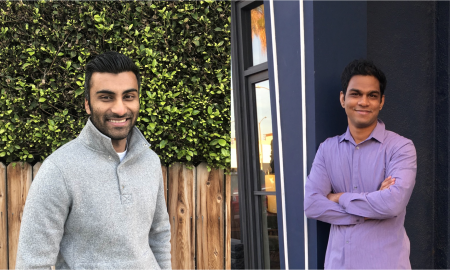






Today we’d like to introduce you to Vanu Bose.
Vanu, can you briefly walk us through your story – how you started and how you got to where you are today.
The company was started in the fall of 1998 based on my PhD work on the topic of software radio. Like many startups we had to adapt and change directions several times until we found success. Initially we realized the technology was not ready for the commercial market, and spent the first several years doing R&D and some defense work. In December 2004, we launched our first commercial product, which was a multi-standard cellular base station, and we got good traction with rural carriers in the U.S. We grew this business for the next few years, and began to sell to carrier in India. Then the economic meltdown of 2008 hit. Wireless carriers stopped investing, we sold almost nothing for two years and had to lay off over half our staff and rethink the business. We refocused to company around our board member Clay Christensen’s theory on disruptive innovation. As a new entrant in business dominated by large incumbents, you have to compete against non-consumption, that is do the things the incumbents either can’t or won’t. We defined non-consumption as anywhere you don’t have good wireless coverage. Carrier would like to have coverage everywhere, and the only reason they don’t is the current technology does not make it cost effective to cover places such as inside of buildings and in rural areas. Our first product was a unique, zero-opex, unbuilding coverage solution that we sold to two large carrier in India. But as we kept looking at the non-consumption markets, one kept popping out: the one billion people in the world with no connectivity. We’ve made it our mission to provide connectivity to everyone, and have create a novel combination of technology and business model that makes it cost effective to cover even the poorest rural areas. This year we launched our fist network using this model in rural Rwanda and plan to cover 1 million people in rural Rwanda who have no connectivity by the end of next year.
We’re always bombarded by how great it is to pursue your passion, etc – but we’ve spoken with enough people to know that it’s not always easy. Overall, would you say things have been easy for you?
We’ve really had three different companies under one roof, the initial R&D company the cellular equipment company and now what we call Coverage as a Service, where instead of selling equipment to operators we sell them coverage. There were many twists and turns and we had to respond not only to a rapidly changing market but also external factors such as the 2008 economic meltdown.
So, as you know, we’re impressed with Vanu, Inc. – tell our readers more, for example what you’re most proud of as a company and what sets you apart from others.
Our mission is to connect all of the people in the world, the reason that these people are not connected today has to do with the economics of how cellular networks are built. In rural areas of developing markets, you have lower population density and lower revenue per subscriber, leading to much lower revenue per cell site. To make matters worse, these areas are usually off grid meaning the cell sites have to run off diesel, so operators spend 1000’s of dollars on diesel while their smaller number of customers spend $1-$2 per month, the economics just don’t work. We changed this equation by combining technology and business model innovation in three ways. First they had to get rid of diesel, it is the largest expense, a high theft item and a disaster for the environment. A typical cell site takes 10kW – 30kW of power which is not economically viable for solar and battery. We took the approach of redesigning the sites equipment and architecture to reduce power consumption. The total power consumption of our sites in Rwanda in 90W, and are sites are 100% solar powered. Second we realized that if every carrier had to build and run its own network, none of them would make money, so we created a wholesale network model. We build and run whole cellular network, but we don’t have subscribers. Instead we strike agreements with carriers to transparently support their subscribers in our coverage areas, and we share the revenue with the carrier. Our first network of this type was in rural America, we have 150 sites in rural Vermont with 10 different carriers, both U.S. and Canadian, using the network. The final piece is the most interesting, because we have found it to be the same in the U.S, Africa and India. Our goal is to cover where people live work and commute. To find out where people are, we analyze satellite imagery to pick out homes and buildings. Across the globe people in rural areas either live in small towns or villages, or otherwise within a few kilometers of some road. In many cases it is not a paved road or even a very good dirt road, but everyone needs some kind of access. We realized that if we cover the road and a few kilometers on either side, we cover most places that people live work and commute. To do this we don’t need big cell towers, in Vermont we put them on telephone poles and in Rwanda we erect 10m poles. Smaller sites cost less, use less land and less energy, plus they focus the coverage where the people are. Together these three innovations give us 10x better economics for coverage rural areas.
So, what’s next? Any big plans?
We are currently raising $4M to complete the 1 million person build in Rwanda, and $2M to expand our U.S. rural coverage. This will prove the economic viability of the model and enable expansion into other countries and across the U.S. We are already planning expansion into several African countries, but we should not forget our own backyard. There are 23 million people in rural America without broadband and 41 percent of the schools in America do not have broadband, we have already connected a school in rural Rwanda with Wi-Fi, and need to do the same for rural America.
Pricing:
- Our capital cost in Rwanda is $10 per POP covered. At that level it is actually possible to cover 1 billion people.
Contact Info:
- Address: 81 Hartwell Avenue
Lexington, MA
02421
USA - Website: www.vanu.com
- Phone: +1 617-864-1711
- Email: info@vanu.com
- Facebook: https://www.facebook.com/VanuInc/
- Twitter: https://twitter.com/vanuinc


 Image Credit:
Chris Wall
Vanu Bose
Getting in touch: BostonVoyager is built on recommendations from the community; it’s how we uncover hidden gems, so if you know someone who deserves recognition please let us know here.