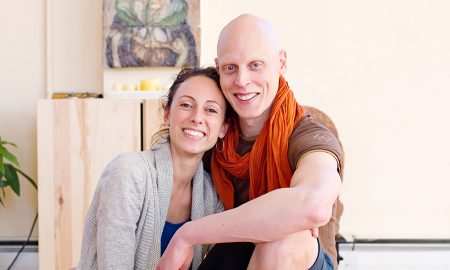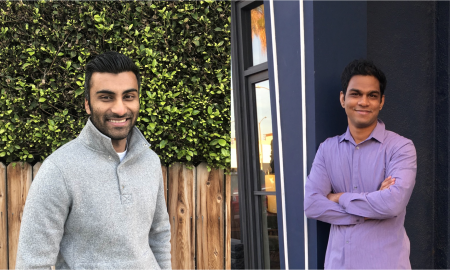






Today we’d like to introduce you to Sarah Beaulieu.
Sarah, let’s start with your story. We’d love to hear how you got started and how the journey has been so far.
I spent the first decade of my professional journey in fundraising and communications for higher education and nonprofits. As a new college graduate, I started my career running the 50th reunion fundraising campaign at my alma mater, Brown University. By my 10th college reunion, I oversaw corporate and foundation relations at Boston College, a role responsible for partnering with university academic partners to secure $20 million in annual revenue.
When I left higher education, I joined an organization called Be the Change, which was founded by Alan Khazei, a co-founder of City Year. Be the Change ran bi-partisan, cross sector campaigns to get big social issues unstuck. It was there that I began to learn how framing conversations about tough social issues helped shape the way people could see themselves as part of a shared solution.
Something that is not on my resume: I’m a survivor of sexual violence. By the time I started my professional career, I was molested by both of my grandparents and date raped by a friend. I showed up on Brown’s campus severely depressed and near suicidal. Like most survivors of sexual abuse or assault, I struggled with making sense of a world where the people who loved me could betray me deeply. But unlike most survivors, I found the help and healing I needed to live my life to its full potential.
Some of that help and healing came in the form of professional therapy, which I was lucky enough to afford and find. But my close friends also played a role in my healing, especially a young man named Russ. Though we knew each other before college, our friendship solidified about a week into freshman orientation when I had the first of many emotional breakdowns in a damp, dormitory stairwell.
I shared, probably for the first time, the details of my trauma. Russ did not know what to do. He did not know what to say. He did not know how to respond. As a young man, he had been taught to fight the bad guys or fix the problem. And if those didn’t seem like viable options, just freeze or run away. Russ didn’t do either of those things, but he was overwhelmed by what he didn’t know. Russ was – and is – a good guy, a great guy. He simply lacked the skill and experience to respond at the moment. Together, over the course of our twenty-year friendship, we figured out how to talk about sexual abuse and assault – and the culture that prevents survivors from seeking help and allows perpetrators to get away hurting others.
My personal experience does not make me an expert. But it does fuel my passion and mission in this work. It’s driven me to a degree in women’s studies, to reading everything I can get my hands on about this topic, to become a rape crisis counselor, to serve on the board of a rape crisis center. And it drove me to spend the last 6 years immersing myself in intensive listening and learning – to leaders of all backgrounds, especially men, to people who work with and alongside survivors, to men and women who have experienced sexual harassment and violence, to leaders in different sectors – about what makes sexual violence such an uncomfortable topic.
Overall, has it been relatively smooth? If not, what were some of the struggles along the way?
Finding a way to speak publicly about sexual violence has not been a smooth road. In fact, my first foray into speaking about it did not go well at all! Five years ago, in an attempt to lessen mens’ fears about false accusation of rape, I created and shared a graphic that compares the likelihood of being falsely accused of sexual assault with the likelihood of going to jail if you actually rape someone.
When I woke up the next morning, the graphic had gone viral, generating international dialogue, debate, and anger. I learned – the hard way – that false accusation is the third rail of sexual violence conversations.
The internet exploded. My friends advised me to not read the comments. I ignored their advice, and read every single one on my phone, hiding under the covers. And behind the rage, I started to see the issue: There’s a false dichotomy that you can’t be in favor of supporting men and women who experience sexual assault and ALSO in favor of a fair and equitable justice system that holds perpetrators accountable without stripping them of humanity.
So, I started over. I used the attention to build a platform and a voice and started to be more curious about other ways to frame and discuss sexual violence, particularly with men.
For young women who are starting out, my advice is to embrace failures and mistakes, even spectacular ones. A failure isn’t going to derail your career or your life. Failing to learn from it will.
Alright – so let’s talk business. Tell us about The Uncomfortable Conversation – what should we know?
The Uncomfortable Conversation, Inc. is a nonprofit dedicated to normalizing conversations about sexual violence, particularly among young men. We believe conversations are accessible, practical and scalable tools that drive individual, organizational and cultural change. The Uncomfortable Conversation has produced 50+ short videos illustrating how men can support survivors, navigate consent, and address troubling ideas or behaviors among peers. The project has been featured in the Philadelphia Metro, WHYY, NY Observer, AskMen and FoxNews, and at events like the Independent Television Festival, Civic Series, Calling All Crows 10th Anniversary Event, and an interactive screening event at HBO.
Next fall, we’ll be hosting a Boston-based screening event featuring content created in partnership with local high school students. If you want an invitation, sign up for our email list!
So much of the media coverage is focused on the challenges facing women today, but what about the opportunities? Do you feel there are any opportunities that women are particularly well positioned for?
Women have the potential to help re-shape for-profit and social entrepreneurship by showing how grit, passion, and resilience can support the growth of healthy and strong organizations. Women start companies and raise families at the same time and find ways to balance both. This is the world we WANT to live in and a world women (and men too) can help shape together.
Contact Info:
- Website: www.theuncomfortableconversation.org
- Email: hello@sarahbeaulieu.me
- Instagram: www.instagram.com/the_conversation_inc
- Twitter: www.twitter.com/sarahbeaulieu
- Other: https://www.youtube.com/channel/UCJ_ublzaHYe8114LQzKT8aA?view_as=subscriber


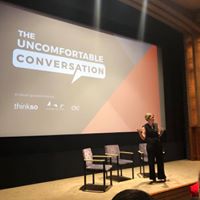
Image Credit:
Marc Beaulieu (survivor photo, Russ photo), Paul Pierson (HBO photos)
Getting in touch: BostonVoyager is built on recommendations from the community; it’s how we uncover hidden gems, so if you know someone who deserves recognition please let us know here.