




Today we’d like to introduce you to Scott Pollack.
Scott, can you briefly walk us through your story – how you started and how you got to where you are today.
I grew up outside of New York City in the 70’s and 80’s – me and my family spent a lot of time in Manhattan going to museums, Broadway shows, and enjoying all the city had to offer. I was first introduced to the architecture and design world through my uncle, who was a communications director for the Regional Planning Association.
He was highly involved in urban planning issues, with a focus on public open space. I was impressed with his work as one of the major proponents for the creation of the Gateway National Recreation Area, one of the first urban national parks, which includes the Statue of Liberty and Ellis Island Immigration Museum. With his inspiration, I developed an interest in architecture, the urban environment, public space and the various issues that impact cities.
When I was in high school in the 70s, NYC was experiencing difficult, yet interesting times. From an architectural perspective, I was intrigued by the opportunities these times offered as well as the difficulties they presented.
In 1982, I moved to Boston to go to MIT, starting out in engineering, and quickly moving into architecture. One of my professors, Jack Myer, was one of the founders of Arrowstreet and another professor, Bob Slattery, was the president of Arrowstreet. Bob ultimately became my mentor, business partner, and friend. Upon graduation, I joined Arrowstreet as an intern, and I’ve been here ever since.
When I first joined Arrowstreet in 1986, I was mostly doing planning work associated with moving people with mental illnesses and developmental disabilities out of state hospitals into community-based facilities. In 1989, I went back to MIT for graduate school, while I continued working at Arrowstreet part-time. Founded in the 1960s, amidst the national wave of urban renewal and redevelopment, the firm has been intensely engaged in urban planning and architectural projects for over half a century.
Just as the city of Boston has successfully transitioned from an industrial hub to a diverse and thriving global city, the firm has grown and transformed with it. Arrowstreet was a pioneer of community-focused planning in the 1980s. From multi-dimensional urban mixed-use projects and master planning to environmental graphics, multi-family housing, hospitality, office, retail and school design, we are collaborative and innovative in our approach.
I spent much of the 90s working on large, retail projects across the Northeast, including the CambridgeSide Galleria in Cambridge, MA, along with other developments in Taiwan. I quickly learned the importance of economics on commercial development and the complexities of the public approval process. I worked with clients and communities to shape projects to meet the economic needs and realities of development, as well as the aspirations (and limitations) of their host communities.
I also learned about how retail is critical to shared public spaces, and that the way in which people want to shop is constantly evolving. As commercial development became more and more complex, I worked with our clients to deliver a broader range of mixed-use project types, including housing, office, and hospitality. Through this, I learned that community issues, aspirations, and economic realities apply to all scales of development and shape the way our communities and cites are put together.
At the heart of Arrowstreet’s practice is the ability to take complex projects and distill them into dynamic design and development opportunities. As architects, we must design for the future. As a firm, our projects today reflect developing social patterns, business trends and anticipated changes in the natural environment.
One example is our attention to building resiliency, rising sea levels, and environmental sustainability. Sponsored by the Urban Land Institute Boston and The Kresge Foundation, we recently took lead roles in the day-long charrette and subsequent report for “The Urban Implications of Living with Water” initiative to contribute to the Living with Water report. We’re the master planner and architect for Parcel K, a vibrant, waterfront development in Boston’s Seaport District. The LEED Silver certifiable project includes an abundance of resiliency measures and sophisticated waterproofing mechanisms.
As online shopping continues to dominate the consumer landscape, successful retailers need to offer elements of surprise and experiences you can’t get anywhere else to be profitable brick-and-motor stores. We’ve found this presents much opportunity to repurpose malls into other uses such as housing, as well as to introduce different store formats, such as small fronts in urban centers. Arrowstreet is assisting Target with the roll-out of small format, urban stores in the Northeast region. The Packard’s Corner store near Boston University is one example of one of these stores.
I’ve led much of the firm’s military work. We perform MWR (morale, welfare, and recreation) master planning and facilities design. We’ve worked with the United States Department of Defense (DoD) to plan healthier military bases that provide better access to services and living needs (such as food, fitness, recreation), to the people that protect us need every day. This has been informed by our collaborative work with hospitality and market specialists at CBRE Government Services and an innovation consultant, Altitude Inc.
Our team has also worked with PKF Consulting on the Healthy Base Initiative for the DoD, which studied innovative and affordable ways to make military installations healthier places to live and work for service members and their families. For all our military work, we used ethnographic research to inform design decisions. Ethnographically is understanding the daily lives of users, the paths of daily travel and the way people actually use space. We need to understand and appreciate the users of the places we help make reality.
We’re also interested in how technological changes in other fields will inevitably change how we design buildings and our cities. With the amount of information and data we are inundated with, how do we use all this new knowledge to our advantage? What should buildings look like now that we can “augment reality” with new types of interfaces which provide access to all this accessible knowledge? How can we use this data to make better design decisions and, maybe more importantly, how can we use data from buildings we already have to test preconceived notions that we’ve always held dear to see if they really make sense? These are the things we think about now.
Take advances in car sharing and driverless cars. They are already changing how we arrive to the buildings. Think about all the extra room we need for Uber/Lyft pick-ups and drop-offs and waiting for our drivers. We need to think, before we build new parking spaces and structures, what they might become as we need less parking because either less individuals are driving, or the cars are driving (and parking) themselves. We created some images that are available here (http://www.arrowstreet.com/portfolio/autonomous-vehicles/) to illustrate how garages may change given autonomous vehicles.
In projects like our work at Logan Airport and Congress Square, we’re exploring mass customization and computer controlled fabrication to help make parts of buildings that were not imaginable when I graduated from MIT. We were responsible for Logan Airport’s Central Parking Expansion, where we completed a kinetic façade—an innovative and beautiful skin with a wind wall that can be seen from the 9/11 Memorial and functions as an elegant backdrop to screen views into the garage.
For Congress Square, we designed a modern addition to a historic building that meshes seamlessly with the surrounding architecture, while adding something new and exciting for Congress Square’s innovation economy tenants.
Overall, has it been relatively smooth? If not, what were some of the struggles along the way?
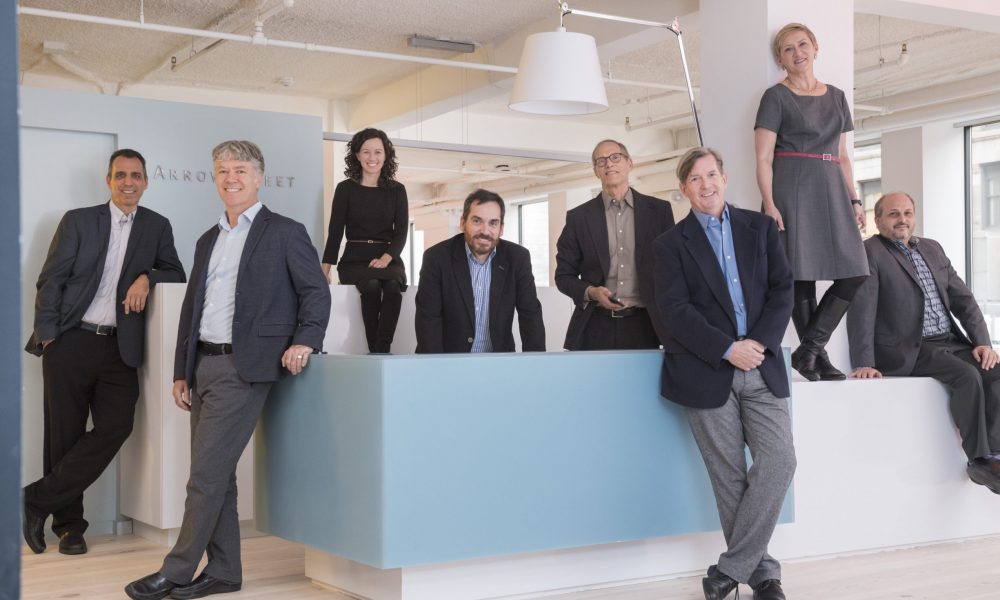
In some ways, you could say that it has been smooth. I’ve been at one firm for more than 30 years, working with a highly-intelligent group of diverse and talented people. The firm has almost 100 incredible architects, planners, graphic designers, and other professionals, with whom my 7 partners and I work with and depend on every day.
On the other hand, the profession, the type of firm that Arrowstreet is, the work we do, and the problems we face as a society have changed radically since the mid-80s. We’ve had to be nimble and learn quickly to advance the firm and the industry. When I started at MIT in 1982, the PC hadn’t been invented. By the time I left, we had a very early version of the email. When I started at Arrowstreet, we still drew by hand. Within a few years, we had a few shared computer workstations for word processing and Lotus spreadsheets (for whom we did their headquarters in Cambridge, MA). Arrowstreet was an early adopter of CAD and I’ve been using AutoCAD since release 1.
From a technological perspective, I’ve lived through every major change in the way we document and design since the development of Mylar Drafting Film and the Rapidograph. Now, of course, we use BIM and 3D-modeling, using tools like VR and AR, to understand and explain our designs to clients and contractors. Now we are starting to think about big data and how that, machine learning and other technologies will start to impact how we think about buildings.
I’ve had one employer but many jobs. Keeping up with the changes in a multi-faceted industry has required learning new skills and changes in approach – I’m not doing the same thing I went to school for because the world has changed around me. We have to assume this change will continue and, at this point in my career, my job is to help Arrowstreet lead the industry with these changes into ways that improve our shared physical environment. We harness our staff’s depth of knowledge and creative thinking to solve the diverse building challenges across a wide range of sectors and building types.
From multi-dimensional, urban mixed-use projects to multi-family housing, hospitality, retail, and schools, we are progressive, collaborative and fresh in our approach. Common questions we ask ourselves every day as astute observers of the environment are – How does this impact development, costs and zoning requirements? How do we design for flexibility? If I’ve learned anything over the last 30 years, it’s that things will change in ways that no one can predict and the buildings we design now will still be around and must work with those changes.
Arrowstreet Architecture and Design – what should we know? What do you guys do best? What sets you apart from the competition?
Arrowstreet is an architecture, planning and environmental graphic design firm that’s been around for more than 50 years – 25 years. The firm was founded as a research-based design firm trying to advance new ideas about public engagement, planning and the ways people lived, studied and worked.
Since our inception in the 1960s, Arrowstreet has continuously evolved, challenging ourselves to re-imagine typical building typologies. There is a spirit of equity on our project teams, where the combination of experience and talent has allowed us to stay at the forefront of the profession. Here at Arrowstreet, interdisciplinary in-house teams sit side-by-side, harnessing their depth of knowledge and creative thinking to solve the most complex building challenges.
Today, we work on a broad range of building types, including housing, retail, hospitality, office, schools, and infrastructure, and mixing all those uses into one development, as well as planning and ways of visually communicating information through environmental graphics. Much of the practice is informed by our history of working with commercial clients to find the best way to develop innovative buildings in a complex, constrained environment (whether the constraints be financial, environmental, physical or related to community concerns).
One of the distinctive things about Arrowstreet is that we’ve never had an easily recognizable “style”. We see every project as a design opportunity to respond to its constraints and context. We come up with unique and project specific designs that reflects our and our clients’ aspirations. We’ve been able to take that approach of understanding our clients’ concerns and apply that across our portfolio, from schools and institutional planning to housing, hotels, and mixed-use.
We are continuing the firm’s research-based tradition working with data-based-design, new fabrication technologies, using VR/AR in the design process, but also considering their implications on the future of the built environment. We’ve even recently added a data-scientist to our staff to find ways to use the vast amounts of data, both we and our clients produce, to improve and innovate in our design process.
What’s your favorite memory from childhood?
A visit to Stratford-upon-Avon and seeing Twelfth Night performed by the Royal Shakespeare Company. I fell in love with both Shakespeare and acting. This led me to join the Shakespeare Ensemble when I was at MIT, act with some wonderful and talented actors (of which, alas, I am not one), and eventually being able to play Festi (the fool in Twelfth Night).
Contact Info:
- Address: 177 Milk St., Suite 610 Boston, MA 02109
- Website: www.solomonmccown.com
- Phone: 617 933 5014
- Email: lmichaels@solomonmccown.com
- Instagram: http://instagram.com/solomonmccownpr
- Facebook: http://www.facebook.com/solomonmccown
- Other: http://pinterest.com/solomonmccownpr/
Getting in touch: BostonVoyager is built on recommendations from the community; it’s how we uncover hidden gems, so if you know someone who deserves recognition please let us know here.