




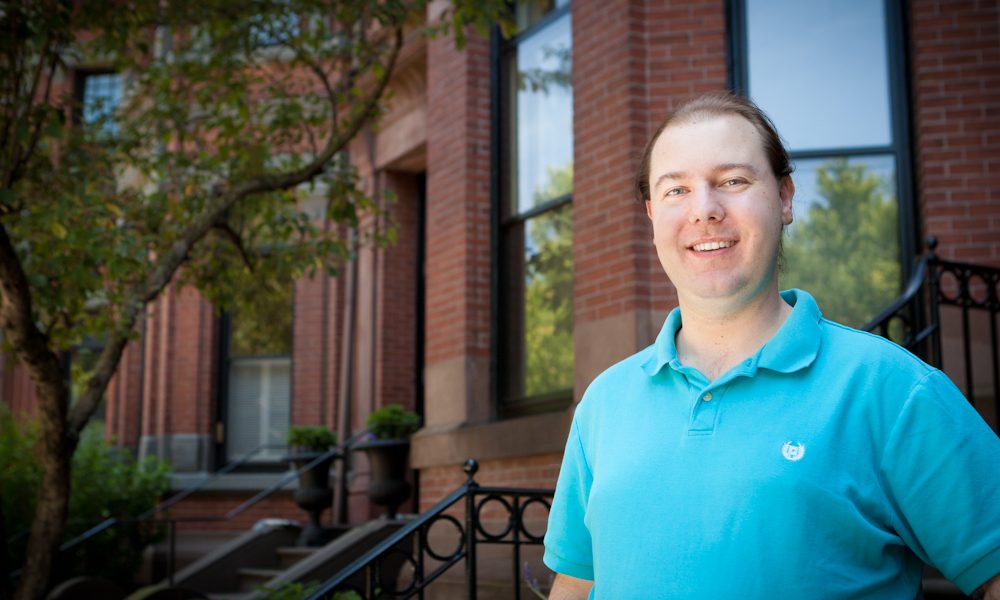
Today we’d like to introduce you to Ryan D. Hayward.
Ryan, can you briefly walk us through your story – how you started and how you got to where you are today.
I have been drawn to both history and architecture for as long as I can remember. You could say it is ingrained in me from my upbringing, schooling and employment.
When I was very young, I had my first brush with the subjects by attending the reenactment of the American Revolutionary War battles in Lexington and Concord. It was an immersive experience among costumed interpreters and the witness houses from 1775. I was hooked on history. So much so that it became a reoccurring tradition for more than two decades.
Once in school, I absorbed every ounce of history that I could get my hands on. I had my teachers to thank because they made learning fun. We took field trips to local landmarks, researched and dressed up as historical persons, read old books and even built models of old buildings and sites. I remember having to build a model of colonial Plymouth out of milk cartons, sticks and straw for the roof. Things got more advanced the following year when I had to construct a center entrance colonial house using coffee stirrers and Elmer’s glue. Legos, Lincoln Longs and K-nex sets all helped further my creativity. This continued through middle and high school. I will admit that I still have Lego models above my desk where I work.
I attended the Boston Architectural College where I graduated in 2012. I was drawn to the school because it was the only one in the country with a concurrent work/teach philosophy. We had to seek and obtain daytime employment where we would gain in the field experience. This would be augmented at night school taught by leading industry professionals. This experience helped me land my first, and many subsequent, positions at architectural firms.
I was lucky enough to have worked my entire career in and around small businesses. My first job was at a bookstore/cafe that opened a window into owning and operating your own business. It also helped me fund my burning desire for books. I built a small library of nearly 4500 volumes and can say I have read most of them. My first architectural related job was likewise a small firm. I worked directly with the principal which allowed me to be a part of all aspects of a project from start to finish. This continued for the next three firms I worked for.
I wanted to turn my attention towards my passion so, after much discussion with friends and family, I left my job to found my own firm. I created The Preservation Collaborative, Inc. knowing that I would not be alone in this venture. I have always envisioned others being a part of the process. I have too many individuals to thank on their own so I convey my gratitude to them collectively. They are certainly aware of who they are and how important a role they have played in my success. I look forward to what the future holds and where we go from here.
Great, so let’s dig a little deeper into the story – has it been an easy path overall and if not, what were the challenges you’ve had to overcome?
The path that one travels to success is like a country road. It’s long, winding and with plenty of bumps. We all know that there are many hidden treasures that lay on the way less traveled so it is important to not take the path of least resistance. This was the mentality I had when I set out on my own. I knew I was in this for the long haul. Never would I have imagined the places where it would take me.
Starting a business from scratch is by far the biggest hurdle I needed to clear. Having read many books on the subject, I knew that most start-ups fail within three years. Determined not to be a statistic, I set out looking to market myself and build my business from nothing. I gave history talks, handed out business cards and had one or two small projects. There was a point where I sat down at my desk and wondered if I would survive. I turned back to previous employers who quickly became mentors. They encouraged me to continue on with my networking. Looking back, I am glad I did. I was able to connect with many persons entirely through word of mouth communication. By the end of year three, I could see why so many people fail. You might think that a client is going to walk in the door all by themselves. At one time, that might have been true. Today, you have to go to your clients.
Once I had a strong network, it opened many doors. I have worked with some of the biggest names in New England preservation. This includes Old Sturbridge Village and Historic New England. I have also worked with smaller organizations such as local historical commissions and societies. I regularly give back by volunteering on some of these organizations. It has been a nice collaboration and one that I hope continues to years to come.
Please tell us about The Preservation Collaborative.
The Preservation Collaborative, Inc. is an architectural design and historic preservation firm. We work with clients, both big and small, to research, renovate and/or repair their buildings in order to preserve them for future generations. Over the years, we have had the opportunity to work on some of the most historic buildings in the region. We don’t just work on landmarks. We enjoy the smaller projects as well. The most rewarding aspect is seeing our clients light up when we detail the history of a house, or show them a potential renovation option. It is what drives us to continue doing what we’re doing.
Our firm specializes in understanding and improving older buildings. This can mean many things to different people so let me explain. The most common services we are doing these days are:
1. House histories: researching the architecture and persons that lived in a building. Most people want to know how old their house was and who lived there.
2. Building renovation designs: from small bathroom and kitchen renovations to large scale additions, we do it all. We try and match the existing flavor of the architecture and bring in the modern lifestyles of our clients so they are happy with the end result.
3. Building restoration projects: we are working with a handful of clients to carefully monitor the ongoing restorations of their historic buildings. Some are just getting started and others are multiple years into phased work. In every case, the buildings were carefully recorded and studied in order to understand them entirely to ensure a successful project.
Our particular services vary from project to project. We strive to tailor our services to each building while maintaining a high commitment to quality.
One of the ways we stand out from other firms is how our depth of knowledge translates directly to our design work. Our staff has a deep knowledge base on which to draw. This comes from decades of work in the field. More personally, I have had the unique opportunity to participate in what is termed as living history. Coming full circle from the days of my youth, I now participate in that immersive hobby that I once witnessed. I portray both eighteenth and nineteenth century personas in order to educate the public about what life was like during those times. It allows me to surround myself with the past in order to better understand it. You can’t get that education anywhere else. I take this first-hand knowledge and use it every day on my projects. This was also one of the reasons why the American Association for State and Local History gifted the firm the Leadership in History award.
I am proud of the way the firm, and its many partners. Are committed to preserving the past. New England is a place rich in history. We want to ensure we have something to pass onto the next generation.
Do you look back particularly fondly on any memories from childhood?
My favorite childhood memory has to be in seventh grade when we visited the Royall House. One of three hometown landmarks, this Georgian era building details the entwined story of the wealthy Royall Family and the enslaved persons who lived there. The house has the only freestanding slave quarters in New England still standing. The ornate architecture, furnishings and intelligent guides all helped me understand and become passionate about the American Revolution. It is one of the reasons why I chose to become a volunteer guide there years later and why I became a living history reenactor.
Pricing:
- The average house history runs between $250 – 500 depending on age.
- The average design/preservation project is usually between $6,500 and $10,500 depending on scope and complexity.
Contact Info:
- Address: 40 Sheridan Avenue
Medford, MA 02155 - Website: www.preservation-collaborative.com
- Phone: 781-241-7253
- Email: Info@preservation-collaborative.com
- Facebook: https://www.facebook.com/PreservationCollaborative
- Twitter: https://twitter.com/NEPreservation
- Yelp: https://www.yelp.com/biz/the-preservation-collaborative-inc-medford
- Other: https://www.houzz.com/pro/preservationcollaborative


Image Credit:
Ron Richmond, The Boston Architectural College and The Preservation Collaborative
Getting in touch: BostonVoyager is built on recommendations from the community; it’s how we uncover hidden gems, so if you know someone who deserves recognition please let us know here.