





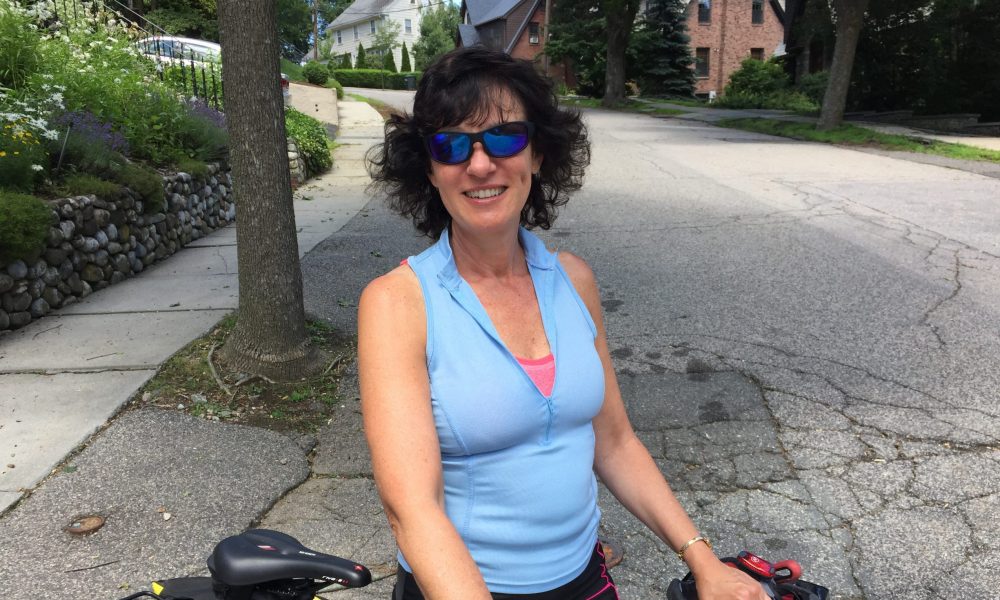
Today we’d like to introduce you to Mariana Nacht.
Thanks for sharing your story with us Mariana. So, let’s start at the beginning and we can move on from there.
I was born in Buenos Aires, Argentina but moved to the states when I was 2 years old. My father is a biochemist and came to the US to do a post-doctoral fellowship in Salt Lake City. We moved around a lot when I was growing up: after Salt Lake City, we moved to the Bay Area (CA) and then to NY. The day after I graduated high school, my parents moved to CT. I went to college in the Boston area (Tufts) and then moved to NYC for 3 years to work in an influenza lab before getting a Ph.D. in Molecular and Cellular Biology from the University of Pennsylvania. I also met my husband in grad school, and we had our first child as we were each writing our theses. I moved to the Boston area in 1993 to do a post-doctoral fellowship with Tyler Jacks at MIT. Tyler was just starting his lab and was an “rising star”. He’s now a bonafide Rockstar. I knew that I wanted to work in industry after my post doc because I was driven by the idea of working on a drug that could help people with a life-threatening disease. I wanted to be as close to that as possible. I went to Genzyme, and stayed for 10 years. Although I worked on many programs, and led some, I never got to see a project all the way through to the clinic. In 2007, I got the opportunity to go to a startup biotech, Avila Therapeutics, that was trying an elegant and innovative approach to designing drugs. I started as the Director of Biology, and the 5th employee. I hired a terrific biology team and together we got 2 drugs into clinical trials for cancer in under 5 years. After Avila was acquired by Celgene, I went to another startup, Padlock Therapeutics, as the 3rd employee. I was the VP/Head of Biology and was responsible for all the biology to develop drugs for autoimmune diseases. For the first 1.5 years, we operated through Contract Research Organizations (CROs), without our own labs. We finally decided to move into our own labs and I hired terrific biologists in both CA and Cambridge. After 3 short months of having our own biologists and labs, Padlock was acquired by Bristol-Myers Squibb. Although it was clearly a success, I loved my job and was sorry to give it up so quickly! My next move was to join KDAc Therapeutics in Feb. 2017 to run the cancer biology effort. KDAc Therapeutics is an even smaller company (I’m the only FT employee right now) dedicated to developing a specific HDAC3 inhibitor for immuno-oncology. We hope to nominate a development candidate by the end of this year. The science is really exciting and interesting, and there is a great opportunity for patients with cancer.
Has it been a smooth road?
One challenge that I faced was being a postdoctoral fellow with a baby. I had to leave to pick up my son from daycare while the other post docs and grad students could and would hang out in the lab after hours. Although I was extremely efficient with my time, and would get to the lab earlier than most, I felt self-conscious for not putting in as much “face time” as others. Both my husband and I were postdocs at the same time, earning $18,000 each, and having to pay $18,000 in daycare. We couldn’t even order pizza once a month!
At Genzyme, I first joined the immunology group because they thought they needed a molecular biologist. It turned out that they really needed an immunologist, so it wasn’t a perfect fit for me. Fortunately, I was able to transfer to a new group and I joined the Gene Expression group which was focused on oncology targets. That was a much better fit and I had terrific opportunities that were aligned with my skills.
In my many jobs, I have had to learn to work with challenging people. Becoming a manager of people meant that I had to develop skills to manage all kinds of people effectively. Each person wants to be managed differently, and it’s not always the way they should be managed to contribute their best!
We’d love to hear more about your business.
WEST was founded in 2000 to provide junior and mid-career level women with skills and a community of support to help them succeed and grow in STEM careers. When WEST was founded, there were very few organizations with this mission, especially in the Cambridge/Boston area. Today, the Boston area is arguably the world’s hub for biotech, and it is becoming a bigger hub for technology. At the same time, there are now multiple organizations that have similar missions, including women’s groups within larger companies. It’s great that the conversation is happening more freely and more vocally. Still, WEST is unique because it is locally focused, and provides learning and networking opportunities for women in both science and technology. We focus on mid-career women to build the skills needed for the next generation of leaders in STEM. While there are plenty of junior women in science and technology, there is still a great gender imbalance at the senior levels. WEST is known for skill-building workshops, signature events where we recognize women in STEM who do extraordinary things in their “spare time” (giving back to the community in impressive ways) and recognizing the next generation of women leaders. Our Board of Directors and Advisory Board are made up of accomplished men and women who are committed to the mission of bringing better gender parity to STEM. We are a volunteer but hard working Board and we provide excellent networking opportunities for the next generation. We recently started a “Breakfast with Rockstars” event for WEST members where they can have an intimate conversation with leaders in various STEM roles. These have been very well received. We firmly believe that men are an important part of the WEST community because we cannot effectively enact change without their support.
Is our city a good place to do what you do?
The Boston area is undoubtedly the most dynamic area for biotech…in the world. Seattle, San Diego and San Francisco also have strong biotech communities but Boston/Cambridge is unmatched for innovative startups. The academic centers of excellence (Harvard, MIT, BU, Northeastern etc), the Partners’ healthcare hospitals, and the top-shelf VCs, bring a synergy that is unparalleled. The ideas, the talent pool and the funding all come together to make first rate companies. Boston/Cambridge is also becoming a hub for technology. Although we aren’t Silicon Valley, we have Google, Microsoft, GE, Hubspot, Carbonite and many others. Again, the universities provide talent and ideas, and the VC community is eager to support the growing technology sector. I think Boston is a terrific area for people starting out in STEM careers!
Pricing:
- WEST membership costs $50/year for students and post docs and $100/year for early & mid-career women and provide discounts for all WEST events
- Breakfasts with rockstars is $10 for members
- Workshops cost $20-50 for members.
Contact Info:
- Website: www.westorg.org
- Email: info@westorg.org
- Twitter: @Sciencewomen


Getting in touch: BostonVoyager is built on recommendations from the community; it’s how we uncover hidden gems, so if you know someone who deserves recognition please let us know here.






Abbey and Phil goldstein
July 24, 2017 at 8:42 pm
great reading your article..congratulations on all yours (and David’s) accomplishments. Keep it going!!!
Anne Cheung
July 24, 2017 at 10:52 pm
I am so proud to know you, Mariana! Congratulations!!!
Jo Viney
July 25, 2017 at 2:25 am
Excellent article! You give so much back to the community – especially for women in science and technology. A real role model for us all. Thank you.