





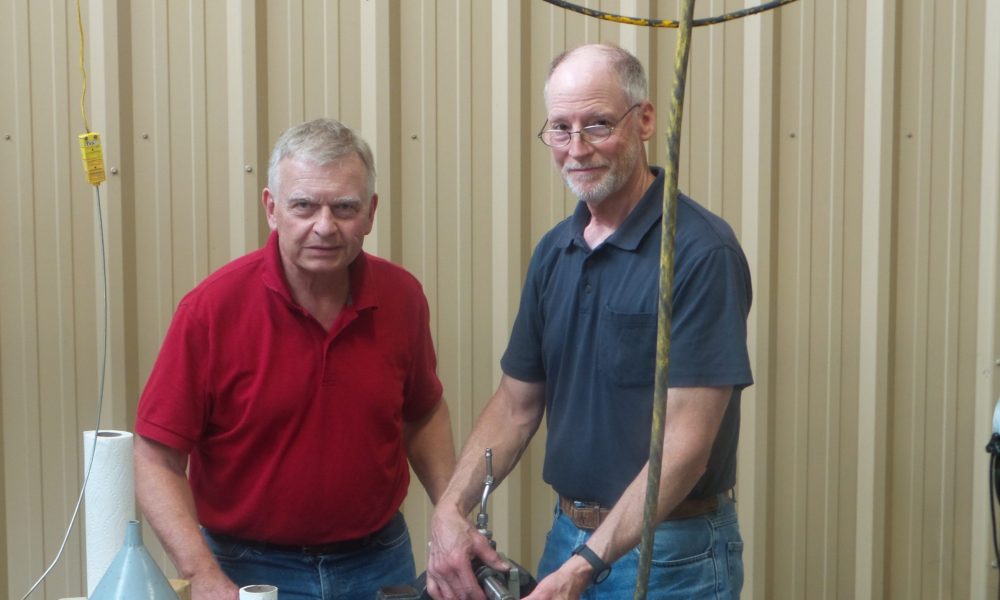
Today we’d like to introduce you to Kenneth Brown.
Kenneth, can you briefly walk us through your story – how you started and how you got to where you are today.
Andrew McClaine and I founded Safe Hydrogen in early 2001. Andy had been working on a project to store hydrogen as a fuel for automobiles. He was working for Thermo Energy which was a subsidiary of Thermo Electron (now Thermo Fisher) in Waltham.
His team came up with a novel idea of using finely ground metal hydride particles as the storage medium. They created a slurry of the particles by mixing them with mineral oil thus creating a liquid fuel with reasonable energy density. Because of the tech slump at that time, Thermo divested all but its core business of precision instruments. I met Andy and agreed with him that the slurry idea had merit. We joined forces and set out under the Safe Hydrogen banner. We applied for and were granted a contract by the Department of Energy(DOE) to explore the use of the slurry as a fuel for vehicles. This contract ended in 2008. The conclusion was that although the slurry could be the least cost method of storing hydrogen on board vehicles, it was only slightly cheaper than high pressure hydrogen and a good deal more complicated. We completed a 400 page report to the DOE.
Our work with the slurry suggested that it could also be used to store energy created by renewable electricity generation by wind and solar. Using electricity to split water into hydrogen and oxygen creates a fuel that can run a generator or a fuel cell that can shift the electricity production to the time and place where customers need it.
We needed to answer some basic questions. What would the cost be? Could the slurry be charged and discharged of hydrogen the many times needed for the 20-30 year life of a wind/solar farm? We procured some angel investment in 2009 and started our research. We found that the cost could be very low since the slurry could be cycled many times with hydrogen without losing capacity. The storage system could have the 20-30 year life needed. We optimized the slurry for this application. It is a different slurry than the one we studied for vehicles. After we studied laboratory sized samples, we scaled the flow of hydrogen in and out of the slurry to the equivalent of 2 kilowatts (KW). After that success, we started the design of a device to flow hydrogen in and out of the slurry at the rate of 25 KW. We just completed construction in July 2017 and are starting the first tests in August 2017. Our next step is to raise $5 million and scale the system to 100 KW.
Our costs to store electricity are lower than any of the competing technologies. We are 20-50 times lower in cost than batteries and about 10 times lower in cost than pumped hydro and compressed air energy storage(CAES). CAES is closest to our costs and, if the right geologic cavern can be used, it would be only 3-4 times as costly. It is clear to us that we are developing the only technology that will allow the electric grid to be powered 100% by renewable energy.
Has it been a smooth road?
We had a slow start starting in 2001 with a lot of discussions with VCs and consultants. The money available was looking for a quick return. We were not “close enough to money” to be interesting to these people. We had to target government and other “patient” money that can wait for technologies to mature.
We are out front with our technology. The electricity generators, transmitters, distributors, and regulators recognize the need for our technology but grid output can be stable for some time to come without using our storage system.
We’d love to hear more about your business.
Our market is to store electricity. To store the energy, we convert electricity to hydrogen by splitting water by electrolysis. The hydrogen is stored in a slurry of magnesium particles. It combines with the magnesium to create a slurry of magnesium hydride particles. The result is that the hydrogen is stored at room temperature and pressure and that the cost of storage is low. Our technology has low enough cost to allow the complete removal of intermittency from wind and solar generation–the wind does not always blow and the sun does not always shine.
To my knowledge, we are the only storage company with low enough costs to keep the cost of generation at today’s levels and still allow us to go to 100% renewables.
If we were to go to 100% renewables using batteries as storage, the cost of generation would rise to $2.00-5.00 per KWh from today’s $0.10 per KWh level.
Is our city a good place to do what you do?
The greater Boston area is a good place to start a business like ours. We have been able to work with people at MIT, Boston University, and UMASS to further our development. The Commonwealth of Massachusetts has programs in place to encourage renewable and storage implementation.
Contact Info:
- Address: 30 York Street
Lexington, MA 02420
Lab work is done at:
95 Robb Way, Fall River Industrial Park,
Fall River, MA 02720 - Website: www.safehydrogen.com
- Phone: 781-572 0334
- Email: kbrown@safehydrogen.com


OLYMPUS DIGITAL CAMERA
Getting in touch: BostonVoyager is built on recommendations from the community; it’s how we uncover hidden gems, so if you know someone who deserves recognition please let us know here.