




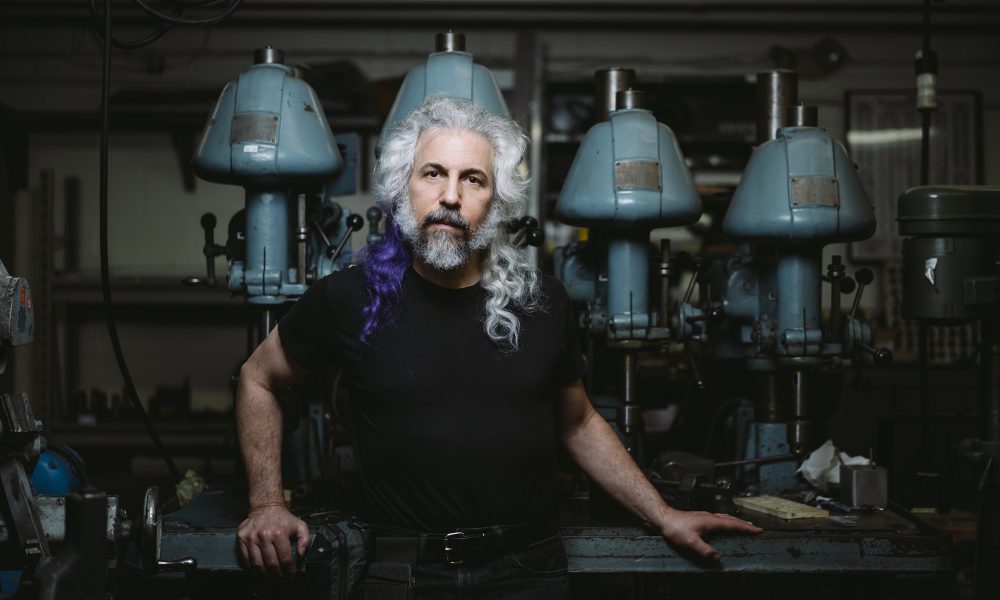
Today we’d like to introduce you to Scott Lefton.
So, before we jump into specific questions about the business, why don’t you give us some details about you and your story.
I’ve always been making things and inventing. By the time I was in high school, I was fairly serious about metal jewelry making, but was also very interested in engineering. I studied electrical engineering in college, but all the while was adding to my metalworking skills. By the end of my undergrad studies, I’d sold metal art through a couple of galleries in Manhattan. Access to good craft workshops was actually a factor in how I chose my grad school.
After earning a Master’s Degree in electrical engineering I worked for half a dozen years as an integrated circuit designer. But all the time outside of work was devoted to metal art and learning woodworking. One of my furniture pieces is featured in Fine Woodworking Design Book Four, and a number of my pieces have won awards in art shows.
My interest in engineering shifted away from electronics and towards mechanical design. I started doing some engineering consulting on the side, and my wife came up with the business name Design Innovation as something that could go in any creative direction. (There are actually several companies with this name today, but I own the trademark.) I took a mechanical and production engineering job that enabled me to learn metal machining, injection molded plastics, CAD, and rapid prototyping, which were also then added to the consulting portfolio.
In 2002 I left the corporate job and became a freelance engineer and designer. I also became a patent agent, and part of my business is doing patent work in the electronic and mechanical fields.
I’m also listed as an inventor on several patents. As Design Innovation, I’ve worked on everything from surgical devices to security hardware to movie props and special effects. There’s a strong crossover between my engineering and my art, and this keeps life interesting.
Has it been a smooth road?
Few interesting roads are smooth or straight. The biggest struggles were in deciding when and how to change direction, and then finding enough client work to pay the bills once I went freelance.
Changing career direction can be terrifying, especially when you have young children. The first major career change was in shifting from electrical engineering to what was essentially mechanical engineering with a large dose of craftwork. That was six years into my engineering career. Fifteen years later I went freelance, and that was its own set of radical changes and gambles. Both of these changes involved long conversations with my wife, a lot of inventorying of skills, interests, and contacts, and a lot of checking on my level of self-confidence.
The first few years of consulting were a steady struggle to land clients and to then produce the sort of work that would keep them coming back for more. There was a lot of luck, but one critical thing was to have the skills in place so I could take advantage of the opportunities when they came along.
So let’s switch gears a bit and go into the Design Innovation story. Tell us more about the business.
The short description of our business would be engineering design, prototype fabrication, and patent services. We position ourselves as a one-stop shop for all of those services. Few companies can do or even understand the details of all three, and that really sets us apart.
One of our major specialties is creating mechanical features to work with electronics. Enclosures are a big part of that, but there’s much more to it. A lot of what we’ve done recently has been in the security RFID space, including anti-tamper devices and environmentally rugged devices. We’ve also done a lot of work in the surgical device field. Unusual solutions to intricate mechanical requirements is something we’re really known for. And for anything we can’t do in-house, we have an excellent network of design and manufacturing partners.
What we’re proudest of is being able to do top-quality design and fabrication on very tight deadlines.
If you had to go back in time and start over, would you have done anything differently?
If I were starting over, I would have done more engineering projects in school and would have made even more use of whatever lab and shop resources there were. Second, I would have done a better job of documenting my early work, both engineering and art. Third, I would have put more effort into building and maintaining my network.
Contact Info:
- Website: www.design-innovation.org
- Phone: 781-883-5666
- Email: slefton@design-innovation.org, scott.lefton@gmail.com


Image Credit:
Travis Alex; www.TravisAlexPhoto.com
Getting in touch: BostonVoyager is built on recommendations from the community; it’s how we uncover hidden gems, so if you know someone who deserves recognition please let us know here.