




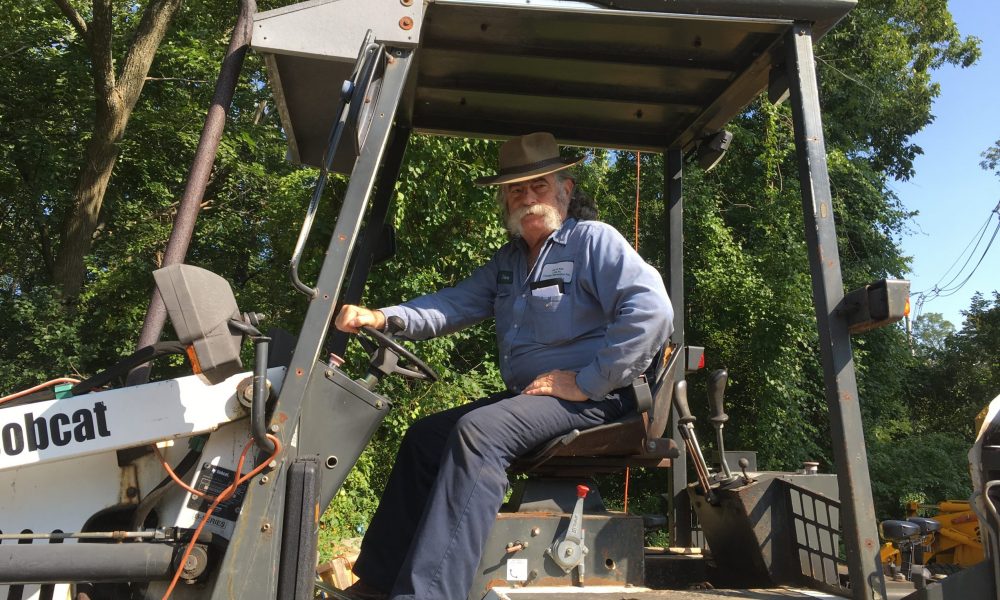
Today we’d like to introduce you to David McKenna.
David, can you briefly walk us through your story – how you started and how you got to where you are today.
You may have wondered how the Ross Family came to be in the field of Cemetery Care. It all goes back to 1921, when John M Ross, a Peabody farmer originally from Nova Scotia, and his wife Frances, bought the old William Goodale Farm, situated where the Danvers Jewish Cemeteries are now located. The old Farmhouse and a small family Burial Ground are all that is left of the Goodale heritage.
The story has it that one day the Sons of Jacob Cemetery had a burial to make, and the man who normally did it was sick, or could no longer perform the task, so they asked my grandfather, John, if he would dig the grave and he agreed. So the story goes, he decided that he could make a better living and work shorter hours digging graves than being a market farmer, working dawn to dusk. So over the next 40 years, he sold off the rest of his farm land to various Temples and Congregations to create new Cemeteries.
After WWII and a stint in the Navy, his son Edward, who had been educated at Essex Agricultural School in horticulture and machinery repair, joined him, and they began to provide their services to other Cemeteries in Peabody and Lynn. Ed bought their first backhoe in 1955, having dug everything by hand before that. Interestingly enough, according to a great article in National Geographic Magazine, Arlington National Veterans Cemetery also bought their first backhoe in 1955.
John retired in the late 50s, and passed away in 1962. Ed married Eleanor McKenna in 1962, and shortly after that she began keeping the records for the Cemetery operations, and in 1965 I, her son Dave, started to work summers in the Cemeteries in 1965. In 1970, I graduated from Stockbridge School of Agriculture at U Mass with a degree in Turf Management and Landscaping, and began working full time as assistant manager.
My step-father, Ed, passed away suddenly in 1972, and Eleanor and I continued the family tradition of caring for your cemeteries.
Eleanor retired in 2010 and I continued to provide services to our various cemeteries, Last year, my nephew Jacob Beaubier joined the team, and is being groomed to take over when I retire.
It is interesting how the industry has changed over the past ¾ of a century. John dug his first grave (we found the burial permit) on July 8, 1929 in the Sons of Jacob Cemetery with a pick and shovel and wheelbarrow. Today graves are nearly always dug with a backhoe, and a truck or gas-powered cart to haul away the excess soil. In 1929, the frost was removed with a sledgehammer and wedges; today we use jackhammers. (Some larger cemeteries actually use a propane powered device to MELT the frozen ground)
In 1929, the cemeteries were mowed once a year with a scythe, just before the Holidays (and my grandfather saved the hay for his cows): when I started in the 1960s we used small 24 inch gas powered mowers and trimmed around monuments and markers with hand clippers: today we use 48-72 inch mowers, and trim with weedwackers. Today 3 men can accomplish what it took a swarm of 8-10 college kids to do. While the equipment is more expensive, it is significantly less costly than paying today’s higher labor rates to so many individuals. AND you don’t have to pay the mowers or backhoe on the days they aren’t being used, or when it’s raining, while you DO have to pay the employees, if you want them to be available when you do need them.
In 1929, John Ross had no telephone. The Temple or Funeral Director would call a lady who lived a quarter mile away on Route 114 who had a phone, and she would hang a red blanket on her porch as a signal for my Grandfather to come up and get the information on the interment. This was all open fields back then: you could SEE Rt. 114 from the house. As it was, John had one of the first phones in Danvers (Danvers 139), but contact was still touch and go. In the late 50s Ed hired an answering service, but he still had to check for messages. And this was in the days when most burials took place the same day or the next day at the latest. In the late 60s we got a BEEPER; it beeped and we had to find a payphone to call the answering service to see who called, then call them back. In the early 70s we got our first mobile phone; mounted in my car. If I was in the truck- no phone. Then the first “bag-phone” that could be moved from one vehicle to another. Then, finally the true cell-phone, and pagers that would print out a phone number or text message; funeral directors can now reach me virtually 24 hours a day. With fax machines, we often fax a sketch of the family lot to the funeral director during funeral arrangements so there is no confusion about which grave the family wants opened. We even fax sketches of the lot to out of state families, as needed to resolve issues.
And don’t forget computer records. Until Ellie got involved in 1964, John and Ed had kept no burial records. She designed an alphabetical card file for each Cemetery listing each lot. The one drawback to the card file was that if the family didn’t know which cemetery their lot was in, you could spend a half hour looking through 25 different cemeteries’ files. Quite often, funeral directors call for families who have no idea what cemetery their lot is in, or people will call looking for the final resting places of their ancestors. But with the computers, we can search through all the cemeteries at once, and have an answer in a few seconds. We can also record much more information, and can print lists or reports as needed, such as Veterans’ lists for Memorial Day flags. Even our MAPS have been scanned into the computers. Thus I can even look up lot information to arrange funerals at home over the weekend if needed.
Many of the Cemeteries had very little for maps and those that did exist were incomplete, had little info on them or cemeteries had changed over the years. We physically went out to the cemeteries, took measurements and redrew them to correct parameters, etc. Furthermore, we marked down all the names, dates of death, types and sizes of each monument and marker on each lot and marked that info onto the maps and into the computerized records.
If we had to operate with yesterday’s tools and today’s labor costs, none of the cemeteries could afford to maintain the level of service we currently provide. Fortunately today’s technology makes it possible to properly and economically care for the final resting places of our Loved Ones. One can only wonder what new inventions will make the care of our Cemeteries even easier. Oh, for a lawn grass that would only grow 3 inches tall and stay green without rain. Or a laser mower that will mow and trim around monuments in one operation, without a human operator. Or a plasma cutter that would slice through frozen ground, boulders or ledge like butter.
Great, so let’s dig a little deeper into the story – has it been an easy path overall and if not, what were the challenges you’ve had to overcome?
One might assume that burying the dead would be a secure job, after all, people are always dying, but as the populations move from the inner cities to other neighborhoods, temples close, and people start to purchase lots in different areas. At one time there were Jewish temples on almost every other street corner in Chelsea, and now there is but one. The cemeteries affiliated with those congregations, now see very little activity, and income is very limited.
Additionally, folks don’t die on a regular schedule, so at times cash flow has been challenging, but we always managed to muddle through.
Another issue is weather. The Blizzard of ’78 shut down the state for a week while emergency crews struggled to get roads open and passable. The same conditions affected the Cemeteries. It is difficult to locate and dig a grave, when there is so much snow, that you can’t even see the gravestones. But a dedicated staff and the proper equipment ensured that burials took place in a timely manner, in the aftermath of that storm, and the several very snowy winters we have experienced since.
Alright – so let’s talk business. Tell us about John M. Ross and Son – what should we know?
We provide full service Cemetery Maintenance, including all phases of landscaping and grounds maintenance, more specifically, but not limited to: mowing and trimming; general cleanup and removal of leaves and debris as needed; loaming and seeding of graves; straightening and leveling of monuments and markers; trimming of shrubs, trees and wild growth; snowplowing and sanding; maintenance and repair of buildings, fences and sprinkler systems; and slice seeding. We also provide Licensed Personnel for application of pesticides and fertilizers; and all the other work necessary to the care, maintenance and beautification of your cemetery. We maintain all of the equipment necessary for the work we do, with backup equipment to ensure the work, especially interments, can be performed when needed.
We provide full service interments, performed by fully uniformed, respectful staff, regardless of weather conditions, providing artificial grass and, where appropriate, a lowering device. Wherever possible, we install cement grave liners, or the sectional liners we designed for tight areas, to preserve the grounds. We loam and seed each grave immediately after the burial, if we cannot replace the sod, and thereafter until the grass coverage is comparable to the surrounding area. We file all burial permits with the proper authorities, to ensure that the Cemetery is in compliance with the laws, and send copies to the Cemetery Secretary.
We keep Fully Computerized Records, in a data base and computerized maps we designed, of every interment, reserved grave, and open grave in each of the Cemeteries we serve, as well as monumentation and inscription data, and next of kin addresses. We keep three pages of data on each lot and grave to enable us to confirm the information given to us by the Funeral Director or Cemetery Chairman. We keep this data up to date, daily, on card files and on cemetery maps, creating such maps if none exist. When we go to the Cemetery to open a grave, we take a photocopy of the map to prevent errors. The original maps never leave the safety of the office.
We have recently purchased and installed a Computer Mapping Program, which we have installed and have downloaded the maps of all the cemeteries we serve into the database. We are in the process of “cleaning up” the digital maps to remove smudges and replace illegible names or dates. We update each map on a daily basis as needed for reservations, interments or memorials, backing up the data on a regular basis. All computer data backup discs are stored at a secure, off-site location. We now also have the capability of producing copies of the maps for any Cemetery who wants to purchase a new updated copy of their map
We provide full service foundation and marker installation services. We check the foundation orders to ensure that they conform to Cemetery policy and size restrictions. We pour foundations on a regular basis so families will not have to wait for the installation of their memorials. We also provide cleaning of granite memorials and refinishing of bronze markers using the manufacturer’s materials and procedures for a professional result. Additionally we recently developed a safe method for straightening large monuments that had settled due to age.
We provide consultation services to Cemeteries to advise them on the myriad of issues facing their organization, from monument regulations to development overview and design. We can and often do provide assistance in Grave sales by showing available lots/graves to prospective purchasers. We keep abreast of new Laws and legal issues affecting the cemeteries in our care.
We also provide full management services to those cemeteries that have need of such services. This can entail any level of service from simply filing permits, to full funeral arrangement and authorizations, to grave sales, to complete management of all records, finances, and day-to-day operation decisions. We currently provide many of these options to all of the cemeteries we serve, providing FULL management for a few.
Additionally, as our contribution to the Community, we fully maintained an abandoned cemetery, well below cost, for many years, for the small contributions a half dozen remaining families make toward the annual effort. We mowed an abandoned Historic Cemetery in Danvers, while they reorganized, and erected several fallen monuments.
I am proudest of the professionalism we have brought to the Cemetery Care industry, our recordkeeping that allows us to assist Families in researching their family history. Even the Jewish Cemetery Association, which owns several cemeteries in eastern Massachusetts, defers to our records when the records they obtained from the cemeteries fall short. I am proud of our dedication to the community; giving back wherever we can assist. We also developed a lightweight sectional grave liner that we can use anywhere, even in the older cemeteries where space is severely limited, to prevent the grave sinking. We also developed a method for straightening large monuments that have tilted over the decades.
Is there a characteristic or quality that you feel is essential to success?
Tenacity, and an unwillingness to admit defeat.
Grampa said, “There’s more’n one way to skin a cat; if you can’t get the skin OFF the cat, maybe you can get the cat outa the skin.”
In other words, turn the problem around and look at it from the other side and you might find a solution. We once had a boulder in a grave that was so large that the backhoe would only lift one side about six inches. So we did that, and shoveled dirt under it; then lifted the other end and shoveled dirt under that. After an hour of switching from one end to the other, we were able to get it to the surface and roll it out of the way, then go back and continue to dig the grave.
Also a desire to ease the journey for families leaving their Loved Ones in our care. It’s all about Care and Caring; not getting rich. As long as I can put food on my table, I’m satisfied.
Pricing:
- Monument cleaning with a pressurewasher and NUSTONE: $100.00 for a family monument; $50.00 for a single; of $25 for a marker
- Straightening a typical monument is $50-100.00; Larger monuments would have to be priced
Contact Info:
- Address: 50 Buxton Road, Danvers, ma 01923
- Website: www.johnmrossandsoninc.com
- Phone: 978-774-0139
- Email: davemckenna50@comcast.net


Image Credit:
David P. McKenna and Elisa Salmon
Getting in touch: BostonVoyager is built on recommendations from the community; it’s how we uncover hidden gems, so if you know someone who deserves recognition please let us know here.