

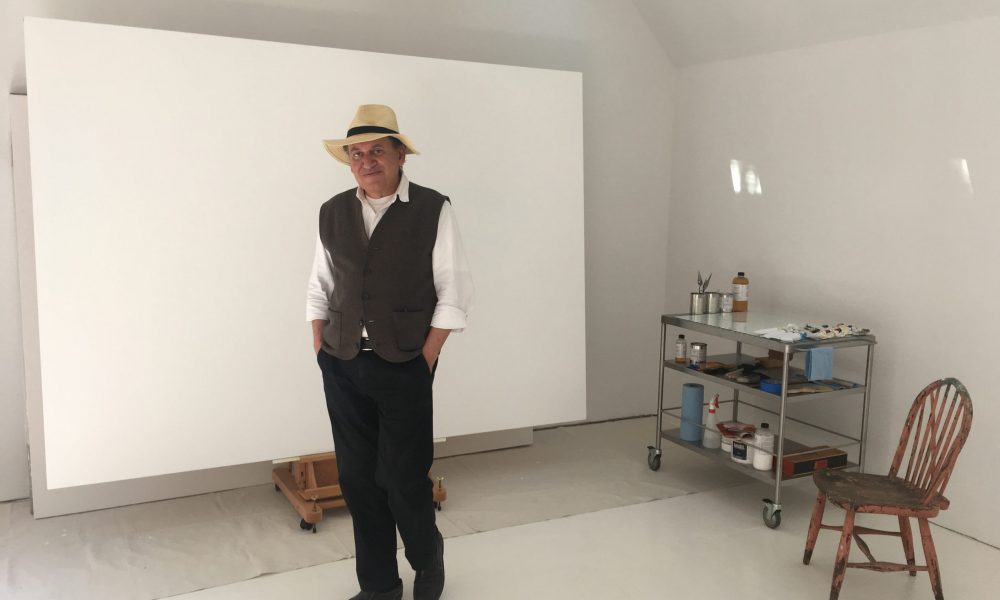
 Today we’d like to introduce you to Wilfredo Chiesa.
Wilfredo was born in Old San Juan, a walled-city dating back to the 15th century, attended Catholic school, served as an altar boy in the cathedral of his hometown and at the age of thirteen created his first painting.
His adolescent fascination with art triggered a lifelong commitment to painting that to this date has produced over 35 solo exhibitions in a broad range of venues and countries. As a corollary to painting, he has worked in prints and drawing, has produced three collaborative limited-edition Artist Books and has created two temporary public art works, one in Brooklyn NY and the other in Venice, Italy.
His father was a sign painter and a Rosicrucian and his mother was a devout Catholic. In the San Juan of his early years the artist profited from a rich cultural environment, attending concerts by the great cellist and composer Pablo Casals, first class exhibitions on early manuscripts, maps and Incunabula at La Casa del Libro Museum – where he participated in a workshop offered by the Queen of England’s Calligrapher – among innumerable other art and cultural events. This effervescent milieu framed his youth and would prove pivotal in his development as an artist.
The artists’ eccentric older siblings also played a particularly important role in laying the foundations for his lifelong dedication to the world of Art and Letters; for example, during a bout of almost monastic passion and reclusion that lasted for nearly two years, one of his brothers spent his time indoors, oblivious to the turning of the world around him, immersed in the reading of books. He would send his younger brother out to buy books by the pound at the town’s small bookshop, and while carrying home the heavy tomes, the artist too fell in love with his load.
Shying away from many of his peers’ interests – such as sports – Wilfredo spent most of his time reading by the San Juan Bay, playing chess and learning to play the guitar with his childhood friend César Díaz, who many years later became a celebrated guitarist in New York and Bob Dylan’s guitar tech and second guitar in many of his concerts.
During his college years he became enthralled by the art of films, assisting every Wednesday night – with almost religious fervor – to the Film Series at the University of Puerto Rico, where he got to see international classics as well as the latest avant-garde films; the discovery of film culture played an important role in his artistic formation.
Wilfredo attended the School of Plastic Arts of Puerto Rico. This academy’s curriculum was modeled after the French Beaux Arts Academy, where the artist underwent a rigorous classical training. Nevertheless, the stimulating vitality of the New York School was an alluring and liberating force that drew him to explore the language of abstraction, or non-objective painting. Some of the most important artists of the time visited Puerto Rico as guests of several institutions, and he got a first-hand taste of their works. He even got to meet some of them; this included Allen Ginsburg, Larry Rivers and Frank Stella. As a young artist in San Juan he befriended the legendary art maven and curator Henry Geldzahler, who would eventually become instrumental in introducing him to the art world of New York.
A defining moment for the young artist was his first visit to New York in the early-seventies, accompanied by a group of like-minded painting students. There he got to see in person what he had known only from reproductions. One particularly memorable exhibition was “Frank O’Hara, a Poet Among Painters” at the Whitney Museum of American Art, in which O’Hara’s poems –printed in large type on the walls- were juxtaposed with works of his painter friends, including Helen Frankenthaler, Willem de Kooning, Jackson Pollock and Jasper Johns. Another show of defining impact for him was a retrospective exhibition of Marcel Duchamp at the Museum of Modern Art. Jazz at the Village Vanguard and the Village Gate, and the mesmerizing architectural wonder of the city complemented the artist’s first-hand encounter with the modernist adventure.
The stage was set: Wilfredo and his fellow young artists would embrace the language of modernity.
Shortly after completing his academic training he embarked on an ambitious project consisting of a limited-edition Artist Book, which he would call “Relatos de un Paisaje Asesinado”. The book encompasses his own creation of original silkscreens and an accompanying poem written for the project by Tomás López Ramírez, as well as a musical score – also composed for the project – by Rafael Aponte-Ledée. This work was so well – received that he was selected to represent Puerto Rico in the Sao Paulo Biennial. He traveled to Brazil, Argentina and Venezuela, marking the beginning of many trips around Latin America that would result in exhibitions in Medellín, Bogotá and Panamá, as well as workshops and artist talks in several Latin American cities.
For the next twenty years the artist participated in numerous group exhibitions internationally, including the Ljubljana Biennial in Yugoslavia, the Fredrikstad Biennial in Norway, the International Print Triennial in Catania, Sicily, the Cuenca Biennial in Ecuador, as well as solo exhibitions in San Juan, New York, Boston, Madrid and Mexico. Site-specific commissioned works include two large-scale paintings at 33 Arch Street, in Boston’s financial district, a mural commissioned by the School of Law at the University of Puerto Rico, permanently installed in their library’s main reading room, and temporary installations in Venice, Italy and New York City.
Wilfredo moved to New York in 1979 and to Boston the following year. A significant and early American experience for him was becoming a fellow at the McDowell Colony in New Hampshire, where he came into contact and developed strong friendships with a distinguished group of writers from New York.
He enjoyed a long academic career in studio art at the University of Massachusetts Boston where he is now Professor Emeritus of Art. He also taught at Wellesley College and Bennington College. While on sabbatical leaves from his academic position Wilfredo has temporarily relocated his studio to Berlin, Madrid, Barcelona, Sicily, Ibiza and Los Angeles. Currently the artist works in Cambridge, Paris, Zurich and Ontario.
Can you give our readers some background on your art?
At 13 years of age I made my first painting and have not stopped since. It has been all about the actual act of painting. The revelation of things invisible. The exaltation of creation. Things metaphysical, spiritual. Things often experienced with eyes closed.
Do you think conditions are generally improving for artists? What more can cities and communities do to improve conditions for artists?
A life in art is as difficult as it is exciting…it has always been. One peculiar characteristic that may define our times is the overwhelming entanglement between art and money. The art critic Robert Hughes declared that the art world was “the biggest unregulated market outside illicit drugs”. Former Phillips auction house chairman Simon de Pury has said: “I know some Rothko buyers—some of the key market makers today—who didn’t know who Rothko was until he reached $40 million.”
One clear issue with artists in the city is space. It has become nearly impossible for even successful artists to locate suitable studio space and establish themselves within the core of city life.
What’s the best way for someone to check out your work and provide support?
Alpha Gallery, Boston:
http://www.alphagallery.com/artists/#/wilfredo-chiesa/
Image Credit:
Photo credit: T.S. MacLeod
Getting in touch: BostonVoyager is built on recommendations from the community; it’s how we uncover hidden gems, so if you know someone who deserves recognition please let us know here.