




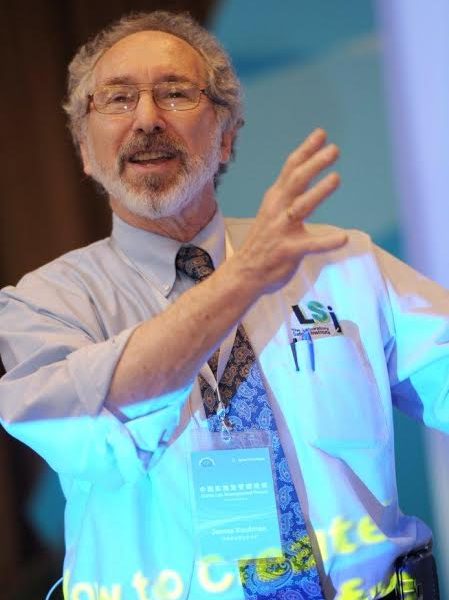
Today we’d like to introduce you to James Kaufman.
Thanks for sharing your story with us James. So, let’s start at the beginning and we can move on from there.
I went to school for 25 years (elementary, secondary, college, graduate, and post-doc). Forty-four years ago (June 9, 1973), I went to work for the Dow Chemical Company (Wayland, MA). On that first day, I learned more about safety than I had learned in 25 years in school.
My supervisor, Don Dix, spent the whole day doing nothing but talking about safety; about my health and safety. Why did he need to spend so much time talking about safety? I thought, this must be the most dangerous place in the world. What I came to realize was that there is no magic to safety, just brute force paying attention.
Either you decide to pay more attention to safety or you don’t. If you do, you get better at it. If you don’t, you just take your chances.
Two weeks later, I turned my round-bottom flask with condenser and calcium chloride drying tube into a roman candle with purple flames and black smoke. Everyone (50 employees) was out on the lawn looking at me and asking what I had done. No one was injured. There was no property damage. I had already extinguished the fire (with potentially the wrong type of extinguisher!).
The next morning, we were all in the conference room. The lab director said: “We want to thank Dr. Kaufman for his display of pyrotechnics. But we hope he’ll confine it to the 4th of July.” I wanted to hide under my chair. Then, he added: “We pay you to do three things. Work safely, do your research, and write your reports and patent disclosures.”
Working safely wasn’t something extra. It was one of the primary colors. It was integral. It was important.
Two weeks later, I was driving home to my apartment in Marlboro. I heard on the radio that there had been an explosion at WPI. I drove back to Worcester to Goddard Hall. I walked up to the second floor to Paul Merrithew’s lab. The fluorescent lights had been blown off the ceiling. The windows had been blown out. The corner of the stone-topped bench with the oak cabinets underneath was gone. It looked like someone had passed a hot knife thru butter. And, Jim Guererra, a grad student, had blown off parts of both hands doing six things that I had learned at Dow on the first day that you just don’t do.
As I looked around, I realized that there was no way that my 25 years in school had prepared me to work up to the standards of the Dow Chemical Company. I decided to try to share what I was learning a Dow with schools and colleges.
My new supervisor, Sue McKinley, encouraged me to write some lab safety guidelines. I did. I wrote “Laboratory Safety Guidelines”. Dow sent the publication to 2000 colleges and universities in the mid-seventies. Within one year, Dow had received requests for a quarter of a million reprints. We had struck a nerve in academia.
Today, more than six million copies of those guidelines have been distributed. They are available in 20 languages. The Guidelines present simple no-cost and low-cost ideas that can create a more effective lab safety program. Some people like to use them as a checklist to see what you’re doing and not doing. Could you start all 40 at once? No. You would make yourself crazy. But you can do something. Pick one. Get started and improve your lab safety program.
I worked at Dow for four years getting increasingly interested in lab safety. One of my most important questions was (and still is) how do you convince people to care about lab safety. The theme of the World Safety 2013 Conference in Kuching Malaysia was “Convincing People to Care”.
I left Dow in the Fall of 1977 (on a one-year leave-of-absence) to “teach” soccer and “coach” chemistry at Curry College (Milton, MA). That academic year, I started the Men’s and Women’s soccer program, created a Chemistry Major, and created the “Laboratory Safety Workshop” (LSW). The leave was extended and I resigned from Dow spending the next 20 years at Curry.
Our primary goal then, as it is today, was to share with schools the simple and inexpensive ideas on how to improve lab safety programs, how to get more people to care. We want to create safer, healthier, and more environmentally friendly place to learn work and live. Our mission was then, as it is today, to make health, safety and the environment an integral and important part of education, work, and life.
Up until 1990, LSW focused primarily on elementary and secondary schools. In my private consulting practice (Kaufman & Associates, K&A) I was beginning to work more with university, industrial, medical, forensic, and R&D labs. With grants from Union Carbide and the National Safety Council, LSW began a program for colleges and universities.
In 1993, LSW moved off campus and was incorporated in 1994 as a 501.c.3 non-profit organization and a Massachusetts Public Charity. I left Curry in the Fall of 1996 (on a one-year sabbatical) and began work full-time on lab safety. The sabbatical was followed by a one-year leave of absence (with benefits) and then resigned. In 1995, we opened our office at 192 Worcester Road in Natick.
In 2002, the organization name was changed to “The Laboratory Safety Institute”. Over the decade, K&A’s clients were invited to be served by LSI as I began devoting all my energies to ensuring the growth and success of the Institute. One K&A client remains, the Department of Defense Education Activity (DODEA). However, the work is sub-contracted to LSI.
The work with DODEA took me overseas to Germany, Italy, Japan, Okinawa, and Korea. Other opportunities beginning in the 90’s resulted in teaching courses and consulting in Mexico, Canada, Thailand, Guam, Taiwan, India, and Spain. In 2008, one attendee at our Pittcon courses was from Saudi Arabia. His interest and appreciation of LSI’s approach to lab safety spawn a host of opportunities in the Middle East not only in Saudi Arabia, but also in Bahrain, Qatar, and Abu Dhabi.
Our involvement with the International Council of Associations for Science Education has led to presentations and course in Australia, Estonia and Malaysia. Agilent Technologies has supported presentation in both Beijing and Shanghai.
The realization that 95% of the eyes and ears are outside the USA (combined with the economical decline of 2008) led LSI to increasingly seek opportunities to share our ideas with the rest of the world.
Today, LSI serves a broad and diverse range of nearly 150 academic and non-academic organizations in almost 30 countries throughout the world. We are an educational organization dedicated to providing educational programs that help interested others to create more effective lab safety programs. Our goal is to help others live safer, healthier, longer and more environmentally friendly lives.
Like all other non-profit educational organizations, LSI is supported by the educational program and educational services that we provide to our students (the individuals and organization that wish to learn from us). Like other educational organizations, LSI has a bookstore (online), received contributions, and has subscribers and both individual and organizational members. Occasionally, we apply for and receive grants.
LSI wants to change the way science is taught and practiced. We believe that learning about lab safety has life-long and societal benefits well beyond the lab. Our mission remains unchanged after 40 years: Make health, safety and the environment integral and important parts of education, work, and life.
Great, so let’s dig a little deeper into the story – has it been an easy path overall and if not, what were the challenges you’ve had to overcome?
Our biggest challenge is very simple; finding creative and effective ways to convince people to care.
In all the countries throughout the world, our students’ question is the same, “I’m here listening. How am I going to convince my colleagues who are not here to care more about health and safety.”
Laboratory Safety Institute – what should we know? What do you guys do best? What sets you apart from the competition?
LSI finds simple and inexpensive ways to convince people to care about health and safety, to grow the culture of safety, to help people live safer, healthier, and more environmentally friendly lives.
Most of the more than 100,000 students who have benefited from our courses and services find our “mental shower-bath” of ideas to be incredibly informative, effective, and entertaining.
One commented: “I’ve been going to safety presentations for 25 years and I didn’t know you could have fun.”
Another said: “I learned more in one day than I have in the past 23 years at xxxx.”
What moment in your career do you look back most fondly on?
For any teacher, I think it’s the return of a student who shares the positive impact of your work on their lives.
One said: “I’ve been teaching chemistry for 30years. When I took your course 15 years ago, it changed forever the way I teach.”
Another said: “I was here two years ago. I left with 20 items on my “Action Ideas” list. I’ve done 18 and came back to make a new list.”
Pricing:
- Registration fees for our one, two, and three-day courses are $495, $875 and $1095 respectively
Contact Info:
- Address: 192 Worcester Street,
Natick, MA 01760 - Website: www.labsafety.org
- Phone: 508-647-1900
- Email: info@labsafety.org
- Facebook: https://www.facebook.com/LabSafety/
- Twitter: https://twitter.com/lab_safety


Getting in touch: BostonVoyager is built on recommendations from the community; it’s how we uncover hidden gems, so if you know someone who deserves recognition please let us know here.