



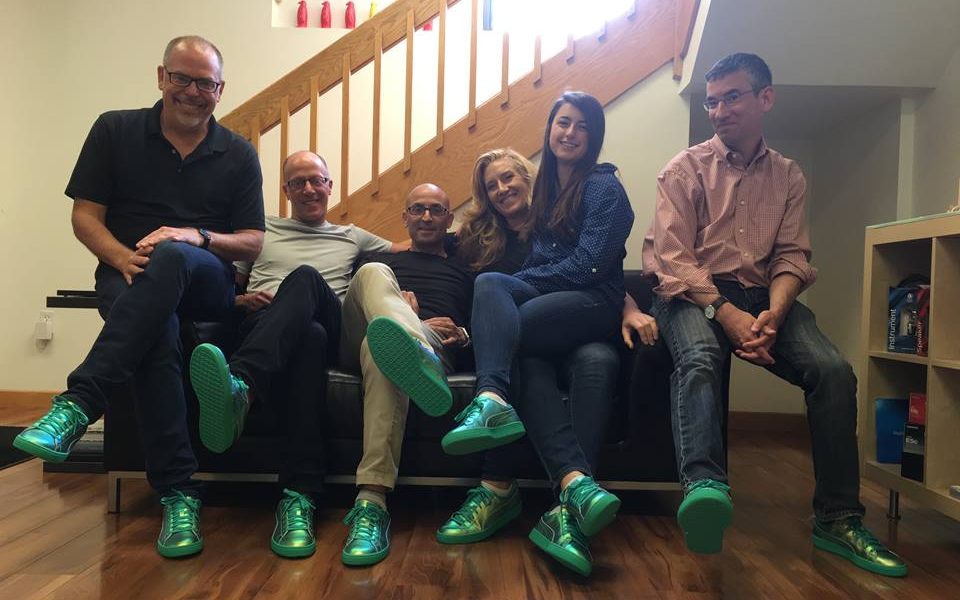
Today we’d like to introduce you to Michael Mooney.
Michael, please share your story with us. How did you get to where you are today?
Catapult Thinking is a brand strategy and design consultancy that turns 20 next year. We work with large global brands like 3M, Experian and Ansell as well as consumer brands like Staples, Harpoon, iRobot and Jack Daniel’s. Apart from a stint early on in Fort Point Channel, we have always been located in downtown Boston, on South Street in the Leather District.
Our principals worked together previously at a large, global interdisciplinary design firm with offices in Boston, London, San Francisco, Columbus and Tokyo called Fitch. In the fall of 1997, two of us left to “startup” in a rental unit of the row home I owned in the South End. In 6 months we had relocated to South Street.
We got our start with brand work Zildjian, the company that makes cymbals for drummers. (A wonderful brand to work with, started by alchemists in Istanbul in the 1620s. Now in Norwell.) We created a novel way to tell the story of hundreds of identical-looking shiny disks at retail through a sound palette that used the language of wine and fragrances to give voice to metal. That work attracted Shure (microphones), Gretsch (guitars), D’Addario (strings), Vandoren (reeds), Bigsby (vibratos) and more. We found a niche. Zing.
Others heard the music. We went on to work with Old Mother Hubbard (pet treats, initially) and then developed the Wellness brand (pet food) with them. Which attracted Halo and Blackwoods (pet foods). Niche two. Woof.
Since any group of clients generally has a musician or pet owner or two or three on the team, we found that our brand stories were often engaging for technology companies (like iRobot, Color Kinetics, Polaroid and Dell) and start-ups alike (like Zink, Ambient Devices and BodyMedia), who all wanted to know if the passion of the music industry could be translated to consumer electronics offers or new-fangled technologies? Yes.
We recently combined our shared interests in “enthusiast brands” (where the zealots are) and “complex product line logic” (where the rigor lives) in an engagement with spirits-maker Brown-Forman to develop a system of brand strategy guidelines for their top shelf: Finlandia, Chambord, Woodford Reserve, Old Forrester, Early Times, Canadian Mist, Herradura, El Jimador, Sonoma-Cutrer and Korbel. Cheers.
Great, so let’s dig a little deeper into the story – has it been an easy path overall and if not, what were the challenges you’ve had to overcome?
Along the way, we found that we enjoy the brand strategy challenges of BOTH large B2B firms with hundreds of products and dozens of brands that need thoughtful wrangling, as well as fascinating start-ups (like Mighteor, Apex Neuro and MeYou Health) where we have the opportunity to build brands from scratch. Pick a major?
Getting the balance right is a challenge and a thrill. Boston is thick with stories to be told about venerable brands (Bose) along with new companies, products, services, and technologies. There are more each month. More each year. There is a lot of new magic in this town. We constantly ask: “Who is a great fit for Catapult Thinking? Sometimes finding the perfect opportunity with a collaborative team, at the ideal point in its evolution, requires a bit of alchemy too. More hours in the day, please.
Please tell us about Catapult Thinking.
We are quite focused on writing as a medium for design thinking—verbal branding and information design if you will, but more often great creative writing that helps bring strategy to life. We call it verbal thumbnails or sketching with language. This can include developing names, descriptors, and taglines for companies, products, services or technologies. But it expands like a gas to encompass: nomenclature and line logic systems for complicated portfolios; and positioning, messaging and content strategies for new-to-the-world ideas (or legacy branded offers that have lost their way). We often then envision what we articulate, through visual identity systems and guidelines, and applications we call “first next” embodiments that help express the nuances of a new brand story. But language drives things, animating the stories and motivating teams.
Do you look back particularly fondly on any memories from childhood?
On the way home from the Lake Isabel, where we swam in the Midwest in the summer, we would always stop at the Dairy Queen for a treat before the long ride home on Tunnel Hill Road—in the station wagon, third seat facing back, or the bed of the pick-up. There was a sign in the window that said: “Let us know if it’s to go. We’ll put a lid on it.” The offer has stuck with me for a lifetime of writing. It’s got it all. Cadence. Clarity. Courtesy. I was just learning to write and read. And it was a discovery: even declarative sentences can have a bit of poetry inside.
Contact Info:
- Website: www.catapultthinking.com
- Phone: 617-350-5277 x22
- Email: mikem@catapultthinking.com
- Instagram: www.facebook.com/catapultthinking
- Facebook: Intstagram: CatapultThinking
- Twitter: Catapult Thinking
- Yelp: Catapult Thinking
- Other: Catapult Thinking


Getting in touch: BostonVoyager is built on recommendations from the community; it’s how we uncover hidden gems, so if you know someone who deserves recognition please let us know here.