




Today we’d like to introduce you to Iain Kerr.
So, before we jump into specific questions about the business, why don’t you give us some details about you and your story.
I was born in Scotland, grew up in Cornwall and went to the University of London. My doctorate is from the University of Southern Maine. In 1987, I met Dr. Roger Payne on a beach in Argentina where he was studying right whales, he was looking for a captain to take a 93 ft. research vessel (unpaid) to the Galapagos Islands. I have worked for and with him since.
I am a generalist, I understand biology but I also understand mechanics, engineering, navigation, education. When I met Dr. Payne on the beach I was looking for a job that could challenge me. I had gone into captaining big sailboats but when you they reach about 100 feet in length then in my mind it is all just back to management again. The idea of captaining a research vessel added new opportunities and challenges and I was soon hooked.
There is so much to do, so much to learn, so many opportunities with marine mammal, ocean science and conservation that it is hard not to be enthused. In this field the ability to think outside of the box is a must. I have now worked in 21 countries and lead over 80 expeditions around the world, from places as close to home as Stellwagen banks and as far away as Papua New Guinea.
I believe that our new future economies are going to be blue and almost any terrestrial business will soon have an ocean element. Locations like Gloucester & Boston are once again going to be important hotspots for new blue global commerce opportunities.
Overall, has it been relatively smooth? If not, what were some of the struggles along the way?
Most people don’t understand that we live on Planet Ocean not planet earth. 71% of this planet is covered with water. It is vitally important that we have healthy oceans.
Sylvia Earle likes to say “No blue, No Green”.
We are a visual species, so when we look at our oceans generally speaking they look fine, as a consequence it is hard to engage people with problem’s they can’t see. We have also found it hard to develop new tools like SnotBot, venture philanthropy is not alive and well in ocean conservation. As a species we are very focused on ourselves, but our own self-interest should have us focusing more on the environment around us,
Alright – so let’s talk business. Tell us about Ocean Alliance – what should we know?
Ocean Alliance is a 501C3 charity that was founded by Dr. Roger Payne in 1971. Dr Payne is best known for his discovery that whales sing songs. Our whale recordings can be found throughout popular culture, in moves such as the Hunt for Red October and Star Trek and as part of the payload aboard the Voyager I and II spacecraft that have now left our solar system.
Our headquarters are in the historic Tarr and Wonson Paint Manufactory on the Gloucester Waterfront. It was in these buildings that they invented anti fouling paint in 1863. We are slowly converting these building’s into an Oceanographic Research, Education and Innovation center.
As a research organization we collect a broad spectrum of data on whales relating particularly to toxicology, bioacoustics, and genetics. From that data we and our scientific partners advise education and policy makers on wise stewardship of the oceans, to reduce pollution, to prevent the collapse of marine mammals, fish populations, and other sea life.
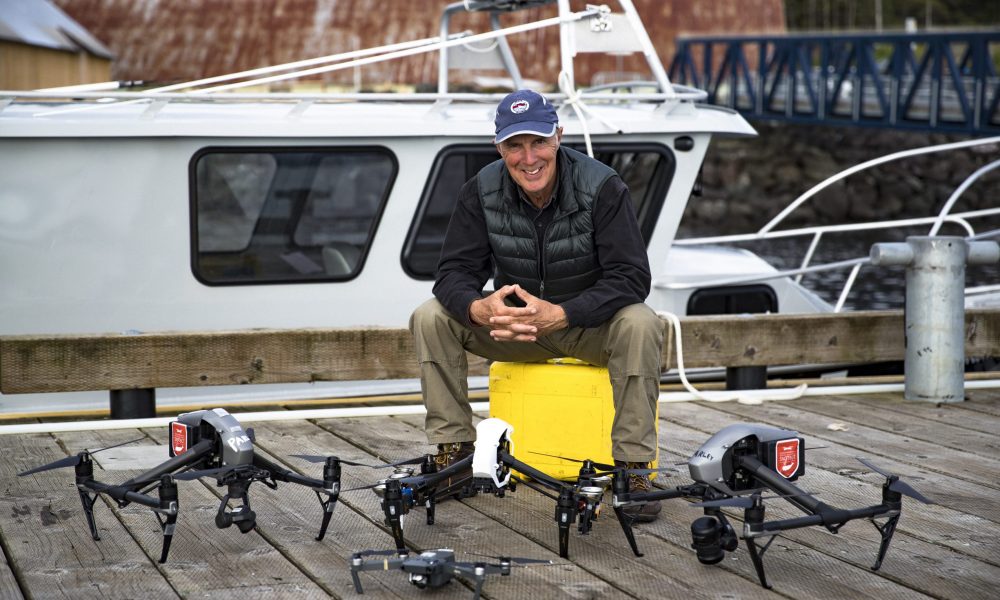
One of our most interesting programs to date is SnotBot. SnotBot is a modified consumer drone which collects the ‘blow’ from a whale by flying directly through it. This ‘blow’ or exhaled breath condensate (EBC) contains a treasure trove of biological information including DNA, stress hormones, pregnancy hormones, ketones and micro biomes. Collecting robust, biological samples from large whales in a non-invasive manner has been a major hurdle limiting our knowledge of these magnificent and ecologically important species. SnotBot, with its capability to collect such a wide variety of immensely valuable data, is changing this. It is truly remarkable to have a single affordable, safe, scalable tool that can simultaneously collect such a variety of data: a capability which has led our CEO to suggest that drones could be to marine mammal research what the invention of the microscope was to cellular biology.
Any shoutouts? Who else deserves credit in this story – who has played a meaningful role?
Ocean Alliance has a broad supporter base – so thank you to all of our donors new and old.
Roger Payne saw something in me in 1987 and I am grateful beyond measure for his mentorship.
Ocean Alliances Board keep me on the straight and narrow so many thanks to them.
The staff and volunteers here are the lifeblood of the organization, on the staff side many thanks to
Mark Hayes, Andrew Rogan, Ann Cortissoz, Rebecca and John Graham, Britta Akerley, John Atkinson & Vicky
Rowntree. As to the volunteers you are too many to thank individually but thank you all!
Last but not least my wife Amy and Daughter Dylan have been incredibly supportive of the constant demands of a small NGO.
Contact Info:
- Address: Ocean Alliance
32 Horton Street
Gloucester MA
01930 - Website: www.whale.org
- Phone: 978 281 2814
- Email: info@whale.org
- Instagram: oceanalliance
- Facebook: www.facebook.com/oceanalliance


DCIM101GOPRO
Image Credit:
Ocean Alliance
Getting in touch: BostonVoyager is built on recommendations from the community; it’s how we uncover hidden gems, so if you know someone who deserves recognition please let us know here.