



Today we’d like to introduce you to Sue Laufer.
So, before we jump into specific questions about the business, why don’t you give us some details about you and your story.
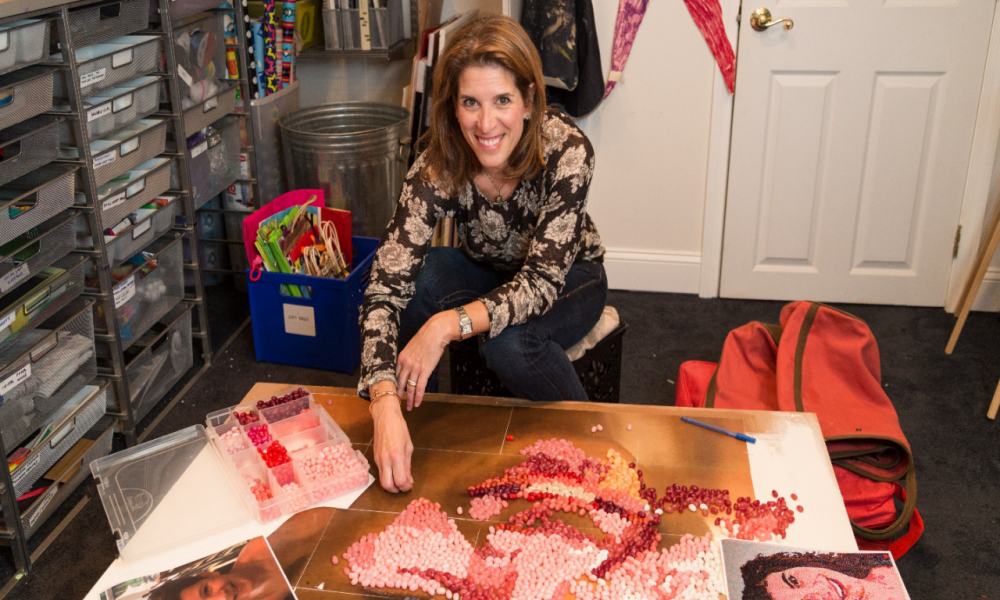
JellyBean Arts started as a labor of love. As a classically trained artist, I had been painting for several years, mostly portraits, and decided to mix things up and experiment with different media. On a trip to the West Coast I discovered the JellyBelly Factory in Fairfield, CA, a massive production facility that proudly displays jellybean art by local artists and offers tours describing the manufacturing process. They produce well over 100 different colors of jellybeans and I walked out of the factory that day with 90 pounds of them! JellyBean Arts was born.
Since then I’ve created portraits for family members, friends and clients who can appreciate the color and whimsy that jellybeans bring to the table. In creating the portraits I strive to capture the subject’s personality by studying client-submitted photos and conducting informal interviews. Each portrait measures at least 4 ft. by 5 ft. and are often larger- larger than life really- the bigger the better as far as I’m concerned!
The production process is painstaking (and I’ll admit, a little obsessive) and lengthy. Portraits can take up to 100 hours to complete and use upwards of 12,000 jellybeans – not counting the ones that fuel the artist 🙂
Overall, has it been relatively smooth? If not, what were some of the struggles along the way?
I believe that every artist faces challenges, especially when venturing into new territory. It’s been no different for me. With regard to jellybean art, the challenges have been technical (how to get those beans to stick securely onto my canvas) but mostly interpretational; unlike oil paints with which infinite variations of color can be generated, jelly beans are limited in variety. There are only so many shades of white, or pink, or blue, for example. The challenge comes when the color I need is not available to me. I draw on the principles of Pointillism, a technique developed by artistic masters in the late 1800’s, who realized that our eyes and brains, when presented with hundreds or thousands of individual dots of color, synthesize the input to create what is perceived as a blended image. The jellybeans serve as the points of color and using them as a medium forces me to combine colors to create an overall effect that often “reads” differently than the individual components. That’s what I find makes this medium challenging but always fun.
Please tell us about JellyBean Arts.
JellyBean Arts is a one-woman show and I work one piece at a time out of my home studio. I’m most proud of the fact that I place emphasis on capturing the personality of my subject and taking risks with color. The magic often lies in the juxtaposition of the inescapably joyful and modest jellybean with a more serious subject.
What sets Jellybeans Arts apart from others? The jellybeans of course. There aren’t many jellybean artists out there!
Do you feel like our city is a good place for businesses like yours? If someone was just starting out, would you recommend them starting out here? If not, what can our city do to improve?
I think Boston is a great backdrop for jellybean art! The Boston art scene, even the pop art scene, is vibrant and exciting!
Contact Info:
- Website: Jellybeanarts.com
- Phone: 617-281-4993
- Email: Sue.laufer1@gmail.com
- Facebook: www.facebook.com/jellybeanportaits


Getting in touch: BostonVoyager is built on recommendations from the community; it’s how we uncover hidden gems, so if you know someone who deserves recognition please let us know here.