





Today we’d like to introduce you to Deborah Reck.
Thanks for sharing your story with us Deborah. So, let’s start at the beginning and we can move on from there.
I got a BA at Yale in history 1990 and an MAT at Brown 1991 and started teaching Social Studies to middle school students in the Baltimore City Public Schools in 1992. I had 35 students in a class, five classes a day in open classrooms in a huge open space with 14 other classes going on at the same time. I saw that the only way I could get those students to read primary and secondary sources carefully and develop ideas about them was to get them to write in response. But, by middle school, many of my students had decided they hated writing or couldn’t write—and it was a struggle just to get them to produce writing. When I could get kids to write, it was always a very powerful tool, but it was a struggle and I didn’t feel like I knew what I was doing. I moved to teach in a suburban school outside of Boston where I thought I would learn methods that would make me more effective, but it was just that the kids were easier, not that there were any more effective methods. So, my husband, who was also a history teacher, and I started this summer program to figure out how to become more effective at teaching writing.
The first incarnation of Summer Ink was in a Cambridge elementary school, and was called The Writers’ Express. In the summer of 1994, we had 12 kids and a van to take the kids on adventures to get them excited about their writing.
We discovered very quickly that we could get kids excited about writing by being attentive readers and focusing our students on the impact of their writing, showing them that, as writers, they could have a powerful impact on each other and the rest of the world. As the camp grew, we invited all sorts of people to come teach with us so that we could try out a wide variety of methods to make even more progress with our students’ writing. Kids wrote in a journal at least twice a day so that we could assess whether their writing was improving and soon we saw that the journal writing itself was the key practice space providing the engine for extraordinary progress in just two-week sessions.
As we developed methods that worked for a wide variety of kids and transferred well to other contexts including camps in other cities and after school programs, schools and publishers started calling on us to figure out how to transfer the method into a classroom experience. It took quite a while to figure out how to transform a method rooted in exploring new activities and practicing physical and artistic skills into a curriculum suited for 45-minute elementary and middle school classes, but over many years, I worked with a thoughtful staff and hundreds of teachers to test lessons in classrooms in urban, suburban, private and public schools and learn which sorts of activities, based in this method, worked for which sorts of writers in more academic settings. We figured out that there are all sorts of ways to get students to love producing writing in the classroom by focusing their attention on the impact of their writing and sequencing their skill development carefully so that they make quick, measurable progress.
By 2007, we had developed the writing program for McGraw Hill’s core English Language program adopted in California and Texas and started to produce our own daily writing curriculum. In 2009, we sold the intellectual property and the name, Writers’ Express to an educational technology company (Wireless Generation, now Amplify), and changed the name of the summer program to Summer Ink. The educational technology company was then bought by News Corporation (yes, that News Corporation, run by Rupert Murdoch, turned out to be a surprising supporter), changed its name to Amplify and invested huge amounts of money to turn The Writers’ Express method into a complete English Language Arts digital curriculum. Ultimately, the state of California adopted this curriculum so that school districts could purchase it for their grade 6 to 8 English Language Arts curriculum.
Meanwhile, the Summer Ink camp continued to operate using The Writers’ Express method to serve hundreds of students from the Boston area and beyond and continue to train new teachers in its innovative method. Last summer, in 2016, I left Amplify and came back to Summer Ink to observe where the program has gone without the daily oversight of its founder. It was very exciting to see the joy campers took in their writing and the way that counselors carefully tracked their daily progress. Over this past summer, I had the opportunity to return to daily operations at Summer Ink as camp director. It was an enormously rewarding experience during which I rewrote the camp’s instructional manual, using what I had learned in my time away. Nationally, educators continue to show interest in our approach, such as educators from a new Milwaukee school who visited Summer Ink this summer, as part of their preparation to implement the new Riveting Results curriculum I have developed for ninth grade students.
Overall, has it been relatively smooth? If not, what were some of the struggles along the way?
The way in which the road has been smooth from the beginning is that there has been overwhelming response from kids and their families for this unique camp experience.
We were surprised by the response because at the beginning, everyone said we were crazy to expect kids to choose to come to a writing camp. The struggle then has been helping people, who are external to the daily experience of the camp, understand the unique combination of students and teaching methods that energize and drive progress at Summer Ink. It is essential that we communicate this unique combination of experiences, teaching methods and opportunity to the Boston community because Summer Ink is dependent on the generosity of the philanthropic community.
People want to know if Summer Ink is for kids who are struggling or for kids who love to write. When we say that both kinds of kids come together and truly learn from each other and that is part of the energy of the camp, many people can’t picture how this dynamic works.
People want to know whether the camp works on “creative writing” or whether we work on being clear and on the “nuts and bolts” of writing. They find it hard to picture our method that focuses kids communicating effectively, depending on a careful sequence of skills that includes “nuts and bolts” as well as what some might consider elements that are more creative like word choice.
People want to know whether the camp is for poor kids or rich kids. The tuition that it costs to run a camp with professional teachers and exciting activities isn’t cheap.
But we work hard to raise money so that at least 50% of our campers receive scholarships.
Fundraising consultants have asked us, why we can’t move to a 60/40 or 70/30 model to become less dependent on fundraising, but it is essential to the culture and effectiveness of Summer Ink that students receiving scholarships are not in the minority—both for those students and for those students paying full tuition. It is what creates a truly vibrant community in which writers have to be clear as well as creative in order to communicate effectively. It is this truly diverse community, as much as Summer Ink’s novel teaching method, that stimulates students’ desire to communicate, and therefore helps to generate the extraordinary amount of writing produced during camp. While it might be easier to raise money for a camp that served only poor students or easier to manage the finances of a camp that provided only a few scholarships, Summer Ink could never achieve the gains in writing for any of its students if it lost its diversity.
Summer Ink – what should we know? What do you guys do best? What sets you apart from the competition?
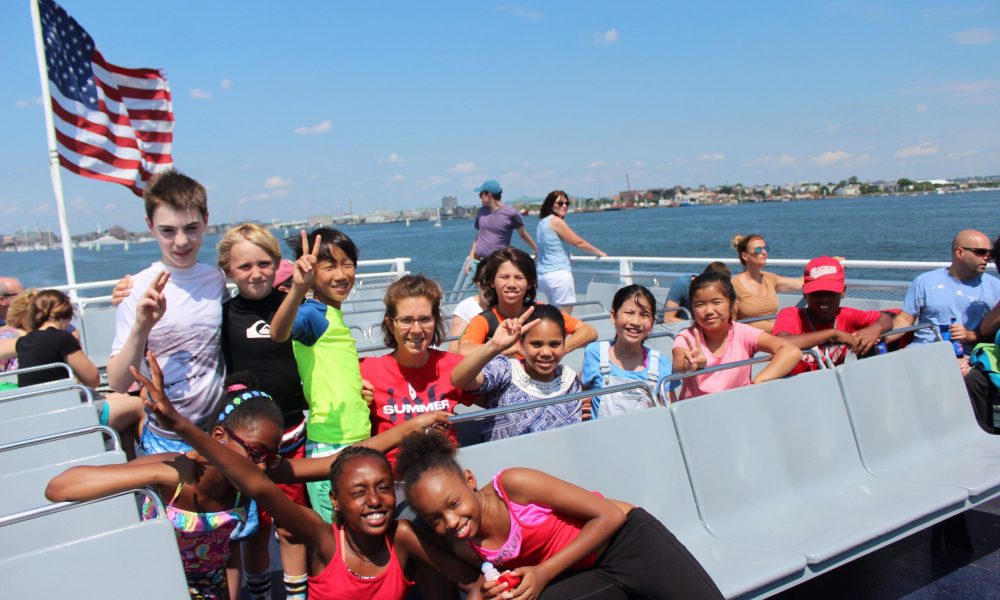
Summer Ink is a dynamic writing camp that helps 5th-10th grade students of all writing abilities develop their unique voice. Our campers explore Boston, engage in exciting arts and sports activities like rock climbing, Broadway dance, ultimate Frisbee, and improvisation, and write about their experiences. Campers respond in writing immediately after an activity ends – while the feel of a boulder, the sensation of a muscle sore from a tough game of basketball, or the beat of a dance is still fresh in their minds. Every morning, counselors give campers feedback about which of their words and phrases had the greatest impact, and campers complete individualized revision assignments using the writing from their journal entries.
Toward the end of their time at Summer Ink, campers work on a longer writing project in which they bring together all of the individual skills they have been practicing.
We work hard to create supportive and demanding classroom environments – ones in which every camper is comfortable sharing his or her writing, and giving and receiving appreciative feedback with fellow campers and staff.
What sets us apart? We provide scholarships to at least 50% of campers, making us one of the most diverse writing communities in Boston. We maintain a 4:1 student-to-teacher ratio, so every camper gets the attention he or she needs to make rapid progress in one two-week session. We have 23 years of experience to draw on, so we know what works to help strengthen the writing skills of a wide range of campers. Our campers enter school in the fall able to write more fluently, with more focus, able to incorporate vivid details into their writing, and with greater confidence. Some of our campers have gone on to become published authors, including Kaitlyn Greenidge, author of We Love You, Charlie Freeman.
What is “success” or “successful” for you?
I personally define success in terms of love and work. I think that was Freud or at least is commonly attributed to him. But I think he was right. In the context of Summer Ink, we think about creating relationships that make kids and counselors want to communicate with each other. And then, we work to structure practice spaces for writing and other skills that enable our participants to write a lot and get better at communication. At Summer Ink, we have some simple metrics for measuring whether or not campers are comfortable sharing their writing in various contexts and whether or not they are able to produce writing that is focused and makes an impact on a reader.
My personal success at Summer Ink is mostly about whether or not I’m helping counselors help campers reach these metrics.
Pricing:
- Tuition is $1580 for one two-week session.
Contact Info:
- Address: In-session Address:
Simmons College, 300 The Fenway, Boston, MA 02115
Out-of-Session Address:
946 Great Plain Ave. #196, Needham, MA 02492-3030 - Website: summerink.org
- Phone: 617-714-0263
- Email: info@summerink.org
- Facebook: https://www.facebook.com/SummerInkCamp/


Getting in touch: BostonVoyager is built on recommendations from the community; it’s how we uncover hidden gems, so if you know someone who deserves recognition please let us know here.