

Today we’d like to introduce you to Catarina Coelho.
Every artist has a unique story. Can you briefly walk us through yours?
I was born in Lisbon, Portugal. I studied painting at the Faculty of Fine Arts of the University of Lisbon and at the Academy of Fine Arts of Brera in Milan, Italy. At the Academy of Fine Arts of Brera in Milan, I studied with master printmaker Giovanni Job. From Giovanni, I learned about stone lithography techniques. During my stay in Italy, I traveled as often as I could, mainly along the west coast. My memories of those travels are a recurrent theme in my early drawing projects.
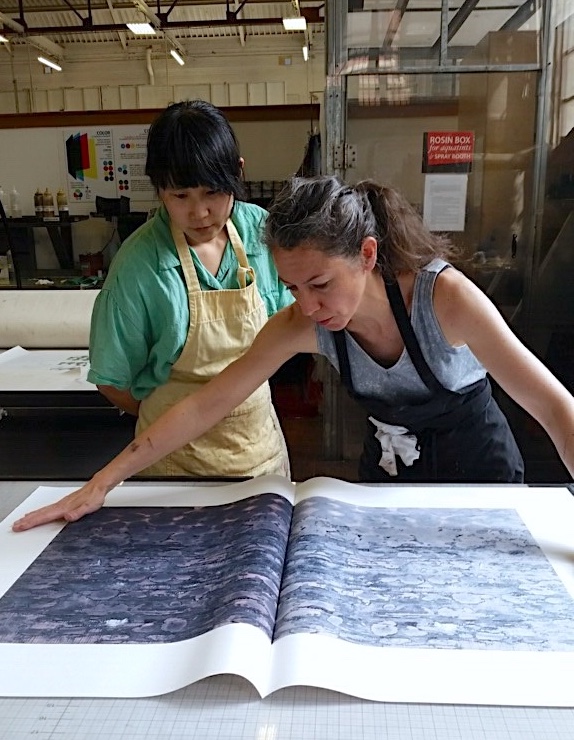
After a brief passage through the Faculty of Letters in Lisbon where I studied Philosophy of Art, I decided to search for art programs in the United States where I could be exposed to other artistic experiences and dedicate more time to my artistic practice. I always had a great interest in the North American post-war artistic panorama, and I wanted to be closer to that tradition. I came to Boston seven years ago and I received an MFA from the Massachusetts College of Art, where I am currently teaching printmaking, and running the Printstudio.
Please tell us about your art.
In my work, I use the media of drawing, printmaking, and painting to explore the subject of landscape as a testimonial site of the human interaction with a territory. Most of my work, in a large sense, is a cartographic representation of my interaction with the landscape. The subject of landscape allows me to interrogate a vast and rich field, full of an extraordinary range of elements and events. In my work, I focus on the physical and symbolic connection I establish with the landscape and with the geographical space, and I use the medium of drawing and printmaking not only to understand the relationship between a particular place and me but also to develop and transform it. Drawing and printmaking are intimately connected, and in my work, I explore the permutations between the two media.
Although printmaking was once relegated to the field of image reproduction, many contemporary artists continue to explore various typologies and strategies in the use of engraving. The more I practice this medium, the more I discover its potential and autonomy. My preference and dedication to the medium of printmaking are also directly connected to my own cultural inheritance, in particular to the fact that in my country, Portugal, printmaking artists expressed a strong political commitment to progressive social change and denounced social inequality during dictatorship times.
My interest in the drawing practice comes from my conviction that drawing can be a complex methodology of representation. The virtue of drawing derives from its diagrammatic nature. As I draw and struggle with the blank paper, I am always hoping that in some kind of velocious flight my hand can bring a thrill to the bareness of the page.
When I’m in my studio, I can never quite predict how the session is going to be. It can be a harmonious session, where I work and the work seems to be getting somewhere. In those sessions, I can draw endlessly. I feel an extraordinary enthusiasm because the ideas that were once blurred in my head start to reveal their conspicuous forms and I finally can make them live in the paper too. However, for the most part of the sessions, there’s a lot of conflict going on. I feel much like a wanderer, sketching here and there, reading and searching for all kinds of things. There are times when my thoughts seem to be disseminated all over, struggling to find a coherent direction. Sometimes, I’m consumed by doubts and I just stare at my work for hours. I stop working at this point. When I began to work the next day, I question the work I’ve been doing so far and sometimes, I find good solutions for my yesterday’s dilemmas. Everything starts to make sense again. At least for a while. I can also spend a studio session tossing away a whole week’s work.
I usually work on many pieces; I like to work on a series of images, it can be diptychs, sequences, or a set. I rarely think of one drawing separately or alone. As for the media, I explore different ones if my ideas require so.
What do you think about conditions for artists today? Has life become easier or harder for artists in recent years? What can cities like ours do to encourage and help art and artists thrive?
Boston needs more art venues for artists to show work. I believe the city doesn’t offer enough art spaces, and art collectives, to accommodate the artistic diversity of the city and surroundings. More art spaces for presenting artwork and projects, and with a strong connection with the community, are crucial for the development of a rich and diverse art scene. There are much more people creating today. The opportunity of presenting work encourages artists to continue making work, to explore, to question, and to propose their ideas. Cities like Boston can help artists thrive by creating more cultural spaces where the multiplicity of artistic languages can be heard. A true creative city echoes polysemy.
What are the biggest challenges facing artists today?
Perhaps one of the big challenges facing an artist today is the lack of adequate time to create work.
In times where here and now is what matters, times of imposed urgency and immediacy, the artistic research is greatly compromised, and, consequently, our cultural development. Today, it is expected of an artist to produce work and show work at an unreasonable pace. If an artist does not meet the expectations of these present times, where right now is the only recent time, then artists are either not committed to their work, or fully dedicated to their artistic practice. This is, evidently, a false idea.
Any artistic research requires time to develop and refine. Only with enough developing time can the outcomes from those researches be serious, meaningful, and purposeful. Artists, scientists, thinkers must be supported in the pursuit of their investigations with the understanding that their projects and explorations need proper time to mature.
How or where can people see your work? How can people support your work?
I have been exiting solo and collectively in several venues in Boston. Most recently, my work is included in the 9th International Print Biennial/Douro 2018, Portugal. The biennial takes place in the oldest demarcated wine region in the world – the Douro. The Douro region is the winner of two heritages of humanity granted by UNESCO and is renowned both for its vineyard landscape and for the archaeological heritage of the Côa Valley. The Douro region is the largest sanctuary of a Paleolithic engraving of the world, and is also in the contemporary scene of the biggest events of graphic art, creating a strength and dimension that goes beyond the borders of the country.
https://www.facebook.com/BienalDouro/videos/2001460606573594/
My print work will also be included in the Second International Print Biennale Yerevan 2019, Armenia, an event organized by the Foundation KulturDialog Armenien.
Contact Info:
- Website: www.catarinalcoelho.com
- Email: catarinalcoelho@gmail.com
Getting in touch: BostonVoyager is built on recommendations from the community; it’s how we uncover hidden gems, so if you know someone who deserves recognition please let us know here.