




Today we’d like to introduce you to Celia Pearce.
Celia, can you briefly walk us through your story – how you started and how you got to where you are today.
I’ve been working in the game industry since 1983. I got into it sort of by accident. My original interests were in film and design, as well as communications. One summer I did an internship at an exhibit design studio while visiting New York from Los Angeles, ESI Design, and a few months later they offered me a full-time job. My first day, I discovered they were making interactive exhibits and attractions, including designing a nightclub with interactive, multiplayer games. We had no idea what we were doing… but I immediately fell in love with the work…
I started out as a writer, then ran the playtest department, eventually working my way up to project manager and lead game designer. I worked there for about 8 years and then moved back to my hometown in LA to work in the theme park industry. My claim to fame there was a virtual reality attraction I designed in 1993 for Iwerks Entertainment using military flight simulator technology. It picked up a number of awards, including the first DICE award for VR (1995). In the late 1990s, I started teaching as an adjunct, and eventually got involved in designing new academic programs, including the USC Interactive Media Program.
Eventually, I got my Ph.D. and worked my way to Georgia Tech in Atlanta, where I worked for six years. My focus there was on the anthropology of massively multiplayer online games, with a particular focus on the intersection between emergent behavior and design; while there I wrote Communities of Play, which is a book about online game refugees. I also helped co-found IndieCade, the independent game festival, which has become quite large and influential.
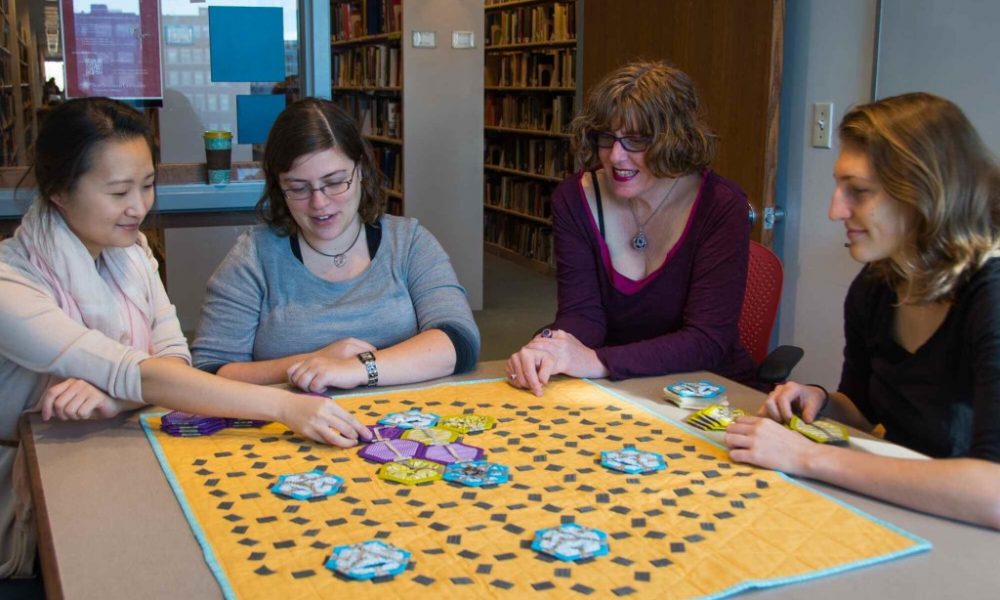
Since coming to Northeastern in 2014, I’ve been focusing on creating experimental mostly non-digital games. The most noteworthy of these is eBee, an e-textile tabletop game that involves building circuits by placing patches on a quilt. The game has shown at a number of festivals and exhibits, including the Smithsonian Indie Arcade, and Boston FIG, where it won the award for Most Innovative Tabletop Game in 2016.
Overall, has it been relatively smooth? If not, what were some of the struggles along the way?
I’ve been incredibly lucky. Most of my career has just been a matter of saying “yes” to opportunities. It wasn’t until later in my academic career that I even applied for jobs.
Most of the positions I had were offered to me. I’ve also made it a point to put myself out there, writing articles and speaking publicly, so this has put me in a position to get those kinds of offers. There have definitely been some bumps along the way. I was a consultant in “entertainment real estate” when the 1990s real estate crash took hold. That was devastating for me and a lot of my business dried up. That was around the time I began getting academic offers so I transitioned at that point to an academic career.
I also have some of the typical stories you hear about gender discrimination, although the first company I worked for was 50% women, which really made a big difference in the culture. I remember doing an interview for a magazine about Booth Babes at amusement park trade shows back in the late 1990s. I also held a job briefly which ended badly when I reported sexual harassment and ended up getting fired as a result.
Later, I was the creative lead on a project where one of the consultants I hired said and did some inappropriate things in public work settings. I took it up with my client and he totally supported me and insisted I fire him, which I did.
In both of those cases I was in a senior management position, and the men were older than me, so I think they were just angry about having to answer to a woman—particularly a younger one— and that’s what spurred their harassment. As I’ve gotten older, I’ve encountered that in more subtle ways, and ageism has also become an issue. I worked on a survey with the IGDA in 2014 and one of the findings was that ageism was listed as being in the top three discrimination categories.
Since then, the former IGDA director has released a “Fifty Over Fifty” list for the game industry, which is a counter to the Forbes “Thirty Under Thirty” list, and which I’m on. Our industry is really obsessed with youth and I think it’s a problem.
Alright – so let’s talk business. Tell us about Northeastern University, Paidia Studios, and Celia Pearce & Friends – what should we know?
Well, I am involved in three companies. The first is Celia Pearce & Friends, which is the entity I use for my consulting business. The “& friends” part is because I do a lot of collaboration and I have a network of people from which I draw on different projects. An example would be that I did some consulting for the Peabody Essex Museum in Salem a couple of years ago, and I brought a few experts with me, who have since developed their own relationships with the museum. The work I’m most proud of here is the VR game I mentioned earlier that won the DICE award in 1995.
Second is IndieCade. I’m one of the co-founders, and the company focuses on festivals and showcases of independent games. IndieCade just celebrated 10 years in 2017, and I’m now working on a book about its history. It’s one of the things I’m most proud of because we’ve been part of the indie games revolution in which various reports estimate that half of all game developers are indie. We’ve played a major role in this by bringing indie games to a broader public, helping to expand the definition of indie, helping to promote diversity, and cultivating a community of brilliant creative minds who’ve built their own career paths through indie games.
Third is Paidia Studios. This is the design studio I started at Northeastern. I do projects with students, which I really love. My students are my muses and my collaborators. We’ve done a number of successful projects. This has been a lot of fun because I’ve been making quirky, experimental mostly non-digital games. The work I’m most proud of since coming to Northeastern is eBee… the quilt game. It’s shown at about a dozen exhibitions, and everywhere we’ve taken it people have asked where they can buy it. My collaborators are super busy, but we are now trying to figure out how to manufacture it as a commercial game.
Here are some links to videos that might be useful:
Virtual Adventure: https://www.youtube.com/watch?v=iA8wSbL4m9E
eBee: https://www.youtube.com/watch?v=bX1zYdNk01c&t=70s
Any shoutouts? Who else deserves credit in this story – who has played a meaningful role?
Wow, that list is too long to enumerate here because I collaborate so much. One thing that really annoys me is how we keep telling these stories about a lone genius who does everything on their own, but in reality, nobody does anything on their own. My longest term collaborators are Stephanie Barish and Sam Roberts, my IndieCade co-founders. Gillian Smith, as well as my students Jeanie Choi and Isabella Carlsson were my collaborators on eBee.
In terms of mentors, I have to say Ed Schlossberg was particularly important since he offered me that first job in the game industry, and also built in me a lot of ideas and ways of working that I’ve continued to hone over time. Other significant people in terms of my career trajectory have been Clark Dodsworth, who first got me writing academic papers, Sara Diamond who brought me to the Banff Centre and introduced me to a lot of different people, including my Ph.D. supervisor Lisbeth Goodman, also an important figure. Three friends who really supported me through my Ph.D. process with whom I later write a book: Tom Boellstorff, Bonnie Nardi and TL Taylor.
Janet Murray, who was the head of the program at Georgia Tech when I was there, has been a longtime friend and mentor. Other key friend/collaborators have been Tracy Fullerton, Mary Flanagan, John Sharp, Jacki Morie, Janine Fron, Cindy Poremba, Holly Gramazio, Susan Gold… I mean the list is really just too long. I also think some credit is due to my family, particularly my sister Aleta Pearce, and some friends who have been significant in supporting my professional and personal development—Steven Lovy, Bob Rice, Gene Preble.
Also the dozens of students I’ve worked with over the years; they are my ongoing collaborators and without them, I’d get nothing done. I hate these kinds of questions because it’s always inevitable that I will forget someone important.
Contact Info:
- Website: www.paidiastudios.com,www.ebeeproject.net
- Email: cp@cpandfriends.com
- Facebook: https://www.facebook.com/paidiastudios/
- Other: www.cpandfriends.com


Getting in touch: BostonVoyager is built on recommendations from the community; it’s how we uncover hidden gems, so if you know someone who deserves recognition please let us know here.